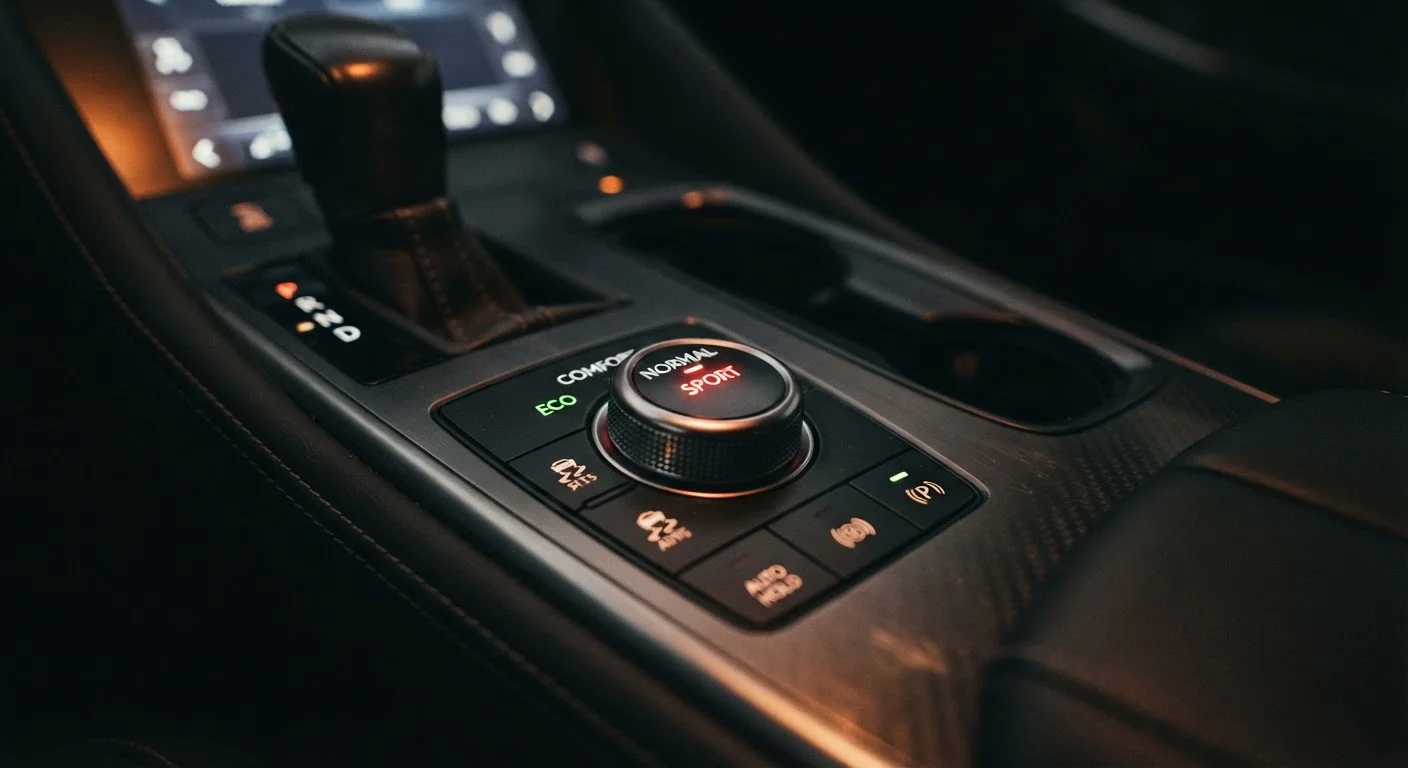
What Changes When You Press Sport
When you select Sport mode, the car's software doesn't unlock hidden horsepower or physically alter the engine. Instead, it swaps the behavioral instructions governing several interconnected systems. Understanding which systems respond — and how — helps you evaluate whether a given vehicle's drive mode suite offers real-world value.
Throttle mapping is the most immediate change. In Normal mode, pressing the accelerator 30% of the way down might command 20% of available engine output — a gentle, linear response designed for smooth everyday driving. Sport mode compresses that curve, so the same 30% pedal press might command 45% output. The engine isn't more powerful; it's just faster to respond. This is why Sport mode feels dramatic even on an unremarkable engine.
Transmission shift points shift significantly. The transmission control unit (TCU) holds gears to higher RPMs before upshifting and downshifts more readily under deceleration. On an 8-speed automatic, this means the car stays in 4th gear through a corner rather than hunting up to 7th. For more on how transmission type affects this behavior, see how different transmissions respond to mode changes.
Steering weight often increases — not through a mechanical change but via the electric power steering system applying more resistance. The steering isn't inherently more precise; it simply feels heavier, which many drivers interpret as more connected.
Test Drive the Modes, Not Just the Car
When test driving, ask to spend time in both Sport and Eco modes — not just Normal. Switch modes during the drive rather than at a standstill. The contrast in throttle feel, steering weight, and shift behavior is the clearest signal of how deep and useful a particular vehicle's drive mode system actually is.
What Sport Mode Doesn't Change
It's worth being equally clear about what drive modes leave untouched. On most mainstream vehicles, Sport mode does not alter:
- Brake hardware or bias — the brake pedal may feel more responsive due to throttle recalibration context, but the braking system itself is unchanged.
- Engine displacement or compression — physical hardware is unaffected.
- Tire grip — modes don't change the contact patch or rubber compound.
- Suspension geometry — unless the vehicle has electronically adjustable dampers (adaptive suspension), which are typically found on mid-to-upper trims or performance-focused models.
Vehicles equipped with adaptive dampers represent the exception where Sport mode produces a genuinely structural change — stiffer damping rates reduce body roll and improve high-speed composure at the cost of ride comfort on uneven pavement. For buyers evaluating spec sheets, this distinction matters. Understanding which performance specs reflect real driving experience helps separate meaningful upgrades from marketing labels.
5–15%
Typical fuel economy reduction in Sport mode
Industry testing and real-world driver data consistently show this range, though exact figures depend on engine type, driving conditions, and how aggressively Sport mode is used.
3–7
Vehicle systems typically adjusted by a full drive mode suite
More comprehensive drive mode systems on mid-to-upper trim vehicles may simultaneously adjust throttle, transmission, steering, suspension, exhaust, and stability control thresholds.
~10%
Potential fuel savings from consistent Eco mode use
Eco mode fuel savings estimates from automaker documentation and independent testing suggest approximately 5–10% improvement over Normal mode in mixed driving conditions.
The Fuel Economy Trade-Off and When Each Mode Is Worth It
Sport mode has a measurable cost at the pump. Holding higher RPMs, delaying upshifts, and demanding more aggressive throttle response all burn more fuel. Eco mode works in the opposite direction — earlier upshifts, softer throttle, and reduced accessory load can modestly extend range, particularly on highway and mixed driving cycles.
The practical guidance is situational use rather than permanent selection:
- Sport mode is genuinely useful for:
- Highway on-ramps where confident acceleration aids safety, mountain passes requiring responsive engine braking, and occasional spirited driving where engagement matters.
- Eco mode works best for:
- Long highway stretches, stop-and-go commuting where smoothness reduces fatigue, and situations where range or fuel cost is a priority.
- Comfort or Normal mode suits:
- Daily urban and suburban driving where neither fuel savings nor performance are the priority — just a balanced, predictable experience.
Hybrid vehicles add another layer. Many hybrids adjust battery charge strategy and motor-assist behavior alongside the conventional parameters. How hybrid powertrains interact with drive modes is worth understanding before choosing a powertrain with both technologies.
When comparing vehicles, ask specifically what each mode adjusts — a salesperson's claim that a car has Sport mode is less informative than the answer to: does it change the suspension, or only the throttle map? Reading performance spec sheets critically can help you ask the right questions before signing.