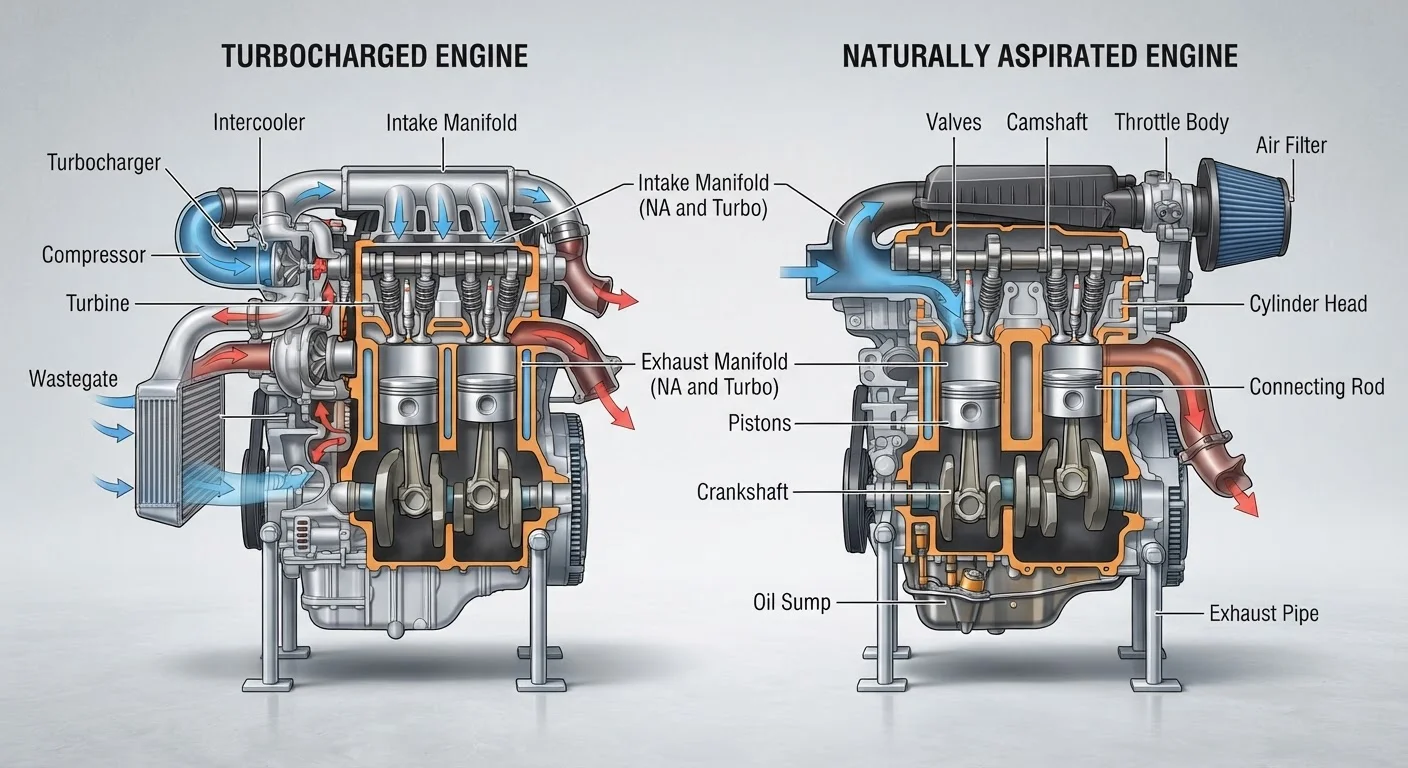
How Each Engine Type Actually Works
A naturally aspirated (NA) engine draws air into the cylinders using only atmospheric pressure. The pistons create a vacuum on the intake stroke, air rushes in, fuel is added, and combustion happens. Simple, direct, and dependent entirely on engine displacement for power output.
A turbocharged engine uses exhaust gases to spin a turbine, which drives a compressor that forces more air into the cylinders than atmospheric pressure alone would allow. More air means more fuel can be burned per cycle — producing more power from the same displacement. This is why a 2.0-liter turbocharged four-cylinder can match or exceed the output of a larger naturally aspirated six-cylinder.
Understanding this distinction matters because it shapes everything from how the car feels at low speeds to what goes on your service invoice. For a deeper look at how these output figures translate to driving feel, see our guide to horsepower vs. torque.
| Criterion | Turbocharged Engine | Naturally Aspirated Engine |
|---|---|---|
| Power per liter of displacement | Higher — boost multiplies output | Lower — limited by displacement |
| Power delivery feel | Surge when boost builds | Linear, proportional response |
| Highway fuel efficiency | Often better at steady speeds | Consistent, easy to predict |
| City/stop-go efficiency | Advantage shrinks considerably | More predictable in practice |
| Mechanical complexity | Higher — turbo, intercooler, wastegate | Lower — fewer ancillary systems |
| Oil change sensitivity | High — turbo bearings depend on clean oil | Standard maintenance sensitivity |
| Typical repair cost profile | More variables at high mileage | Generally more predictable |
| Engine weight | Often lighter for equivalent output | Heavier for similar power levels |
Power Delivery: What You Feel Behind the Wheel
The difference in how power arrives is one of the most tangible ownership distinctions. Naturally aspirated engines deliver power in a smooth, predictable arc — press the throttle, get proportional response. Many drivers find this linear feel confidence-inspiring, particularly in traffic or on winding roads.
Turbocharged engines can exhibit turbo lag — a brief delay between pressing the accelerator and feeling the surge of power, as the turbo spools up. Modern engineering has reduced this dramatically through twin-scroll turbos, electric wastegates, and smaller, faster-spooling units. But some lag remains at very low rpm, and when boost arrives, power can come in a noticeable wave rather than a steady climb.
Neither character is objectively better. Some drivers love the punch of a turbo hit; others prefer the predictability of a naturally aspirated unit. This is worth experiencing on a test drive rather than reading off a spec sheet — as we explain in our overview of which performance specs actually matter.
Fuel Economy: Promises vs. Reality
The case for turbocharged engines rests partly on the premise that a smaller, boosted engine uses less fuel than a larger naturally aspirated one producing equivalent power. In controlled testing, this often holds true — particularly at steady highway speeds where the turbo operates efficiently.
Real-world results are more nuanced. If you drive aggressively, frequently entering the turbo's boost range, fuel consumption climbs quickly. Short urban trips mean the engine rarely reaches optimal operating temperature, and the turbo's efficiency advantage evaporates. Drivers who exploit a turbo's performance regularly may find fuel economy closer to — or occasionally exceeding — what a larger naturally aspirated engine would use.
~20–35%
Typical real-world efficiency gap vs. EPA estimate
Studies by the EPA and independent automotive researchers consistently show turbocharged vehicles can fall further below their rated fuel economy when driven assertively compared to larger naturally aspirated alternatives.
100,000+ rpm
Turbocharger turbine rotational speed
Turbocharger turbines commonly spin well above 100,000 rpm under load, explaining why clean, high-quality oil is critical to bearing longevity.
The takeaway: EPA estimates for turbocharged vehicles can be harder to replicate in everyday conditions than those for naturally aspirated equivalents, especially for drivers with a heavier right foot or heavy urban commutes.
Maintenance, Reliability, and Long-Term Costs
This is where ownership realities diverge most sharply. Turbochargers operate under extreme heat and rotational stress — some units spin at over 100,000 rpm. They require a steady supply of clean, properly pressurized oil to lubricate their bearings. Skipping oil changes is riskier with a turbocharged engine than with a naturally aspirated unit; heat-soaked oil degrades faster, and bearing damage can follow.
Best practice with a turbocharged engine includes allowing a short idle-down period after hard driving (to let oil continue cooling the turbo before shutdown), using the manufacturer-specified oil grade, and adhering strictly to service intervals. Some owners also consider more frequent oil changes than the official schedule suggests — though this is a judgment call best made with your mechanic's input.
Naturally aspirated engines have fewer components exposed to this level of stress. There's no turbo to fail, no intercooler to develop a boost leak, no wastegate actuator to replace. Over high mileage, this simplicity tends to translate into a more predictable repair cost profile. That said, modern turbocharged engines have improved substantially in durability, and many reach high mileage without turbo-related issues when properly maintained.
Common myths about turbo unreliability are worth examining critically — our article on engine performance myths that trip up car buyers addresses several of these directly.
For buyers evaluating used vehicles with turbocharged engines, maintenance history becomes especially important. See our guide to understanding the real cost difference between new and used cars for a broader framework on evaluating total ownership cost.
Used Turbocharged Vehicles: Check the Service Records
When buying a used turbocharged vehicle, maintenance history carries more weight than with a comparable naturally aspirated car. Look for evidence of consistent oil changes at or before the manufacturer's recommended interval, and ask whether the correct oil specification was used. A turbocharger that has been run on degraded or incorrect oil may show wear that isn't immediately apparent on a test drive but can lead to costly repairs later. A pre-purchase inspection by a qualified mechanic is always advisable.