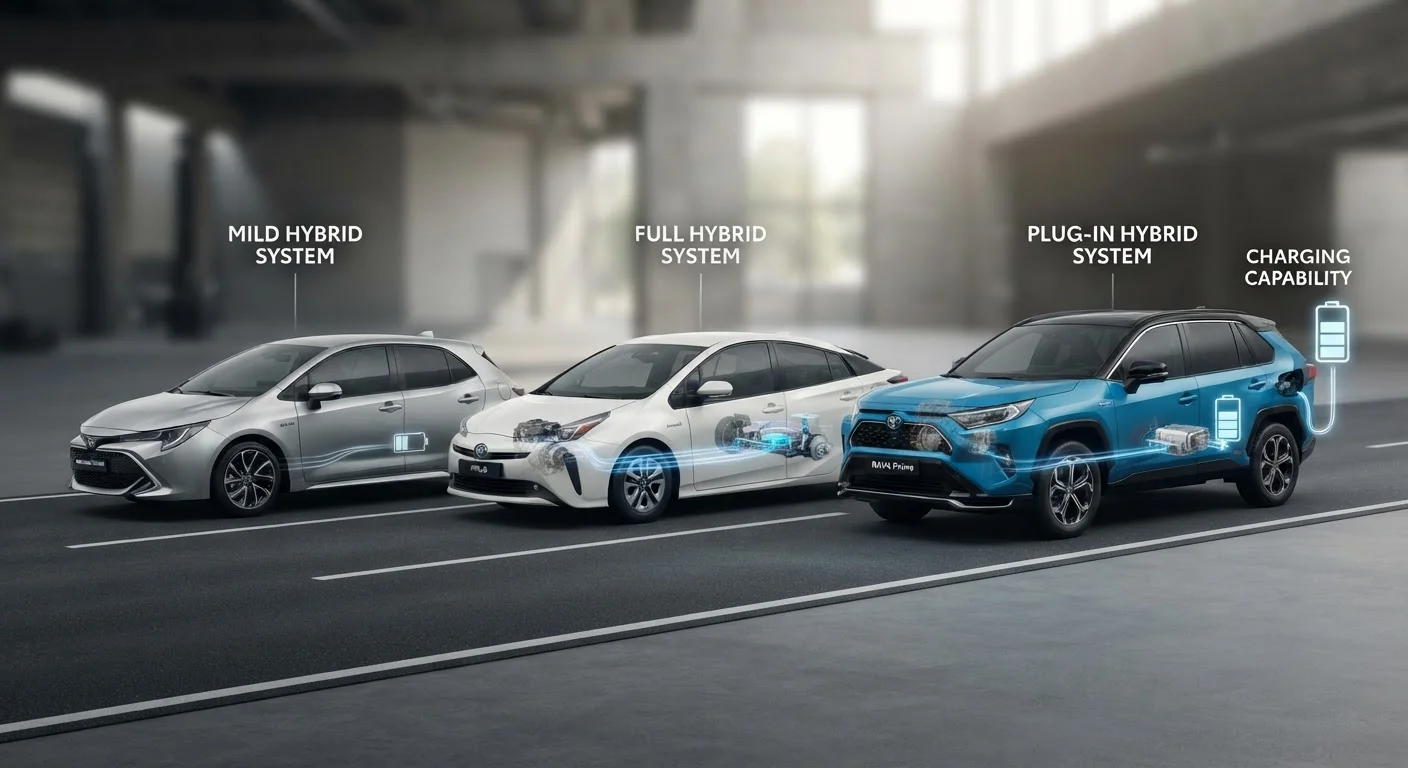
Why Hybrid Type Matters More Than the Badge
Walk into any dealership and you'll encounter cars wearing the word "hybrid" with very different engineering underneath. A mild hybrid and a plug-in hybrid can look identical from the outside, yet one requires a charging cable and can travel 30-plus miles on battery alone, while the other simply helps the engine feel a little more responsive. Understanding the distinction before you shop prevents you from paying for capability you'll never use — or buying a system that doesn't fit your driving patterns.
For a broader look at how these powertrains compare against petrol and fully electric options, see our powertrain comparison guide.
Mild Hybrid: A Helping Hand, Nothing More
A mild hybrid (often labeled MHEV) pairs a conventional internal combustion engine with a small electric motor-generator — typically powered by a 48-volt battery. The electric component captures energy during braking (a process called regenerative braking) and feeds it back to assist the engine during acceleration or to power accessories. Critically, it cannot propel the vehicle on its own; the gasoline or diesel engine is always running when the car moves.
The practical effect is a modest improvement in fuel economy — generally in the range of 5–15% depending on driving conditions — and slightly smoother power delivery. The system is transparent to the driver; there are no EV driving modes to manage. Mild hybrids are typically the least expensive hybrid variant and carry the smallest weight penalty.
Where mild hybrids underperform expectations is stop-and-go city traffic. Because the electric motor can't sustain the car on its own, the efficiency gains are smaller in urban environments compared to full hybrids. If city driving is your primary use case, a full hybrid usually delivers a more meaningful return.
Full Hybrid: Self-Managing Electrification
A full hybrid (HEV) takes the concept further. It uses a larger battery and a more powerful electric motor capable of propelling the car independently at low speeds — typically under 25 mph. The powertrain management system decides automatically when to use the engine, the electric motor, or both, requiring no input from the driver.
This is where hybrids genuinely excel in city and suburban traffic. Stop-and-go conditions that punish conventional engines are ideal territory for full hybrids, because the car can lean heavily on the electric motor at low speeds and recharge the battery under braking. Highway driving at steady high speeds, by contrast, reduces the opportunity for electric assist, so the fuel economy advantage narrows considerably on long interstate stretches.
Full hybrids do not plug in — the battery charges exclusively through regenerative braking and the engine. That self-sufficiency is a key selling point: no charging infrastructure is needed, making them a genuinely drop-in replacement for a conventional car. For a deeper look at how they compare specifically against plug-in hybrids, our plug-in vs. full hybrid guide covers the distinction in detail.
| Mild Hybrid (MHEV) | Full Hybrid (HEV) | Plug-In Hybrid (PHEV) | |
|---|---|---|---|
| Can drive on electricity alone | No | Yes, at low speeds | Yes, up to 20–50 miles |
| Requires external charging | No | No | Yes, for full benefit |
| Best efficiency gains in | Highway assist | City/suburban traffic | Short electric-range commutes |
| Battery size | Small (48V) | Moderate | Large |
| Typical price premium over non-hybrid | Lowest | Moderate | Highest |
| Infrastructure needed | None | None | Home or public charger |
| Weight added vs. conventional | Minimal | Moderate | Most (large battery) |
Plug-In Hybrid: Electric Range on Demand
A plug-in hybrid (PHEV) builds on the full hybrid architecture by adding a significantly larger battery — large enough to provide a meaningful all-electric driving range, typically between 20 and 50 miles depending on the vehicle. That battery can be recharged from an external source: a standard household outlet, a Level 2 home charger, or a public charging station.
For drivers whose daily commute falls within the electric range, a PHEV can run almost entirely on electricity day-to-day, with the gasoline engine available as a backup for longer trips. This combination appeals to people who want the practicality of a combustion engine for road trips while enjoying lower running costs on routine drives. How hybrids perform on long trips is worth reviewing if highway travel is a regular part of your life.
The PHEV proposition breaks down if charging access is limited. Without regular recharging, the vehicle operates as a heavier, less efficient version of a full hybrid — because it carries a larger battery without using its electric potential. Buyers in apartments without dedicated parking, or those without workplace charging, may find the full hybrid a more honest match for their situation.
Note: All-electric range figures for PHEVs are tested under standardized conditions and may vary with temperature, driving speed, and load. Real-world electric range is often lower than the rated figure.
Choosing the Right System for Your Driving Life
The clearest way to assess which hybrid type fits you is to map each system's strengths against how you actually drive, not how you imagine you might drive.
- Daily mileage under 30–40 miles with charging access: A PHEV can cover most of your driving electrically, making it a strong candidate.
- Mixed city and suburban driving, no charging access: A full hybrid delivers the best real-world fuel savings with zero infrastructure requirements.
- Primarily highway driving: All three systems lose their efficiency edge at sustained highway speeds; the cost premium for any hybrid requires careful consideration here.
- Tightest budget among hybrid options: Mild hybrids typically carry the smallest price premium over an equivalent non-hybrid model.
For a side-by-side look at how these systems translate to specific vehicle segments, the hybrid powertrain overview for sedans and hatchbacks offers useful context. A plain-English breakdown of all electrified powertrain types — including fully electric — is also available in our MHEV, HEV, PHEV, and BEV guide.