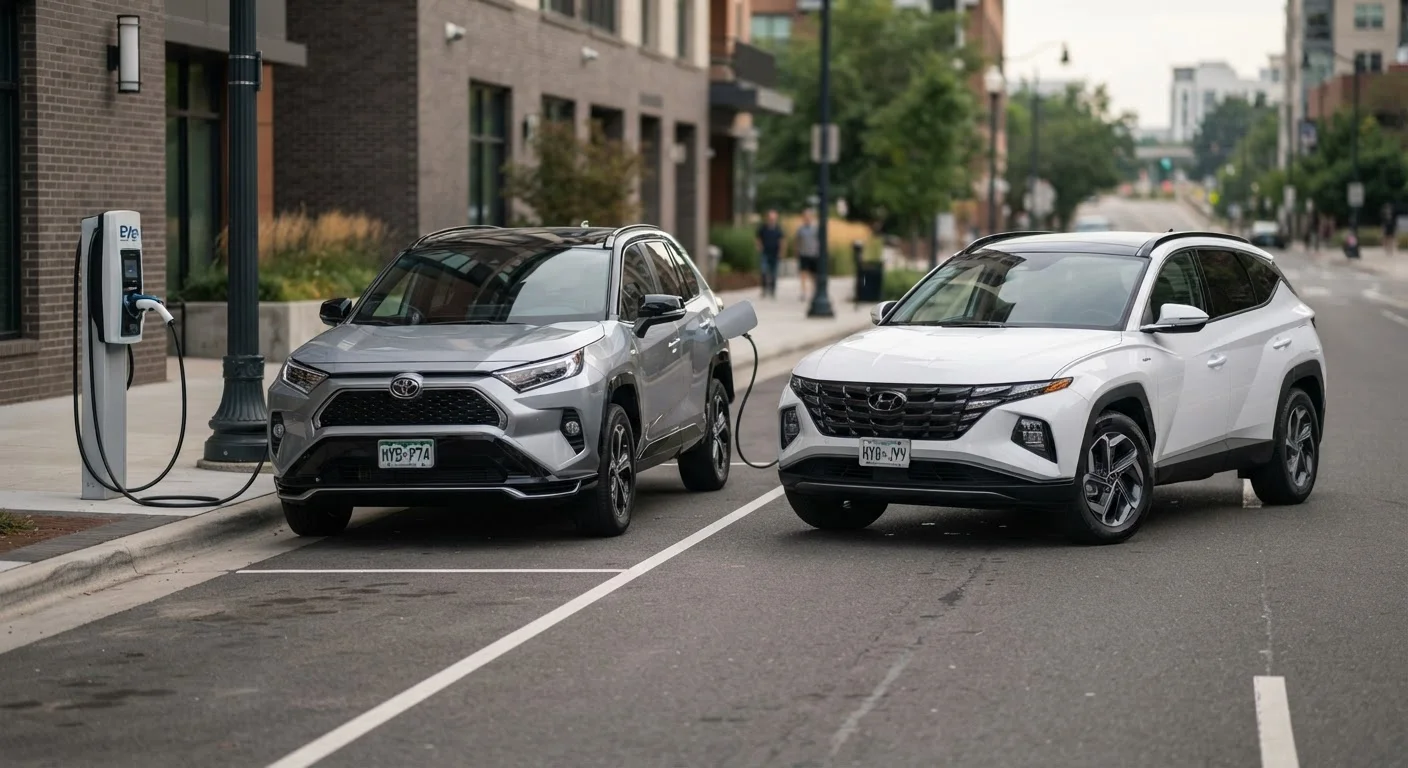
How Each System Works
Despite sharing the word "hybrid," plug-in hybrids (PHEVs) and full hybrids (HEVs) achieve their efficiency gains through meaningfully different architectures. Understanding those differences is the first step to knowing which suits your life.
A full hybrid combines a gasoline engine with an electric motor and a relatively small battery pack - typically 1-2 kWh. The system charges that battery internally through regenerative braking (capturing energy when you slow down) and through the engine itself. The driver never plugs in. The vehicle's onboard computer manages all transitions between electric-only, gasoline-only, and combined power modes, usually without any perceptible shift. At low speeds or during light acceleration, many full hybrids run on electricity alone for short distances, then the engine kicks in seamlessly.
A plug-in hybrid uses the same basic dual-powertrain concept but adds a substantially larger battery - commonly 8-20 kWh - that can be recharged from an external power source. When fully charged, a PHEV can operate in all-electric mode for a defined range before transitioning to hybrid operation like a conventional HEV. That electric range varies by model but typically falls between 20 and 50 miles. Drivers who plug in regularly and travel fewer miles than that range can run almost entirely on electricity day-to-day, reverting to gasoline only on longer trips.
For a broader look at how these systems fit into the full spectrum of electrified powertrains, see our plain-English breakdown of hybrid and EV types.
| Criterion | Plug-In Hybrid (PHEV) | Full Hybrid (HEV) |
|---|---|---|
| Battery size (typical) | 8-20 kWh | 1-2 kWh |
| External charging required | Yes - plug-in required | No - self-charging |
| Electric-only range | 20-50 miles (typical) | 1-2 miles (low speed only) |
| Upfront cost vs. HEV | Higher | Lower |
| Federal tax credit eligibility | Often eligible (up to $7,500) | Generally not eligible |
| Fuel savings consistency | High if charged regularly | Consistent across all use |
| Infrastructure dependency | Charging access needed | None beyond gasoline |
Cost, Charging, and Real-World Savings
PHEVs carry a higher sticker price than comparable full hybrids, primarily because of their larger battery packs. However, new PHEVs that meet certain criteria may qualify for a federal tax credit of up to $7,500 under current U.S. tax law - a meaningful offset for eligible buyers. Always confirm eligibility with a qualified tax adviser, as income limits and vehicle-specific rules apply.
20-50 mi
Typical PHEV electric-only range per charge
Range varies by model and battery size; EPA ratings provide standardized estimates for each vehicle.
40-50 mpg
Typical full hybrid combined fuel economy
EPA combined ratings for compact and midsize full hybrid sedans commonly fall within this range.
$7,500
Maximum federal EV tax credit for eligible PHEVs
Under the Inflation Reduction Act, qualifying new PHEVs may be eligible; income and vehicle-price limits apply.
Fuel savings depend heavily on how you actually use each vehicle. A PHEV driven mostly within its electric range and charged regularly can approach the economics of a battery-electric vehicle for daily commuting. The same PHEV used without regular charging - relying solely on its gasoline engine and the inefficiency of carrying a heavy battery - may underperform a standard full hybrid on fuel economy. Full hybrids, by contrast, deliver consistent and predictable efficiency gains across all use patterns, with the EPA typically rating them 40-50 mpg in combined driving for compact and midsize sedan applications.
Home charging equipment (a Level 2 charger installation) adds an upfront cost for PHEV owners, though many utilities offer rebates. Charging from a standard 120V household outlet is possible but slow - a full charge may take overnight or longer. For drivers who rely on public charging infrastructure, costs and convenience vary significantly by location.
Our overview of hybrid powertrains in sedans and hatchbacks provides additional model-level context for buyers evaluating specific body styles.
Which Type of Driver Does Each System Suit?
The clearest factor separating PHEV and HEV suitability is your daily driving distance relative to a PHEV's electric range - and your realistic access to charging.
If your round-trip commute is consistently shorter than your PHEV's rated electric range and you can charge at home or work, a PHEV offers the most flexibility: low operating costs on short trips, and full gasoline backup for road trips without range anxiety. This profile suits suburban and urban drivers with predictable routines.
If your driving is less predictable - long highway miles, frequent unplanned trips, or no access to a home charger - a full hybrid is the more practical choice. It delivers real efficiency gains without any behavioral change or infrastructure requirement. For buyers weighing new versus used options in either category, the new vs. used car tradeoffs are worth reviewing, since used PHEVs may have degraded battery capacity that affects electric range.
Neither system is universally superior. The right choice depends on your commute, charging access, budget, and how much complexity you're willing to manage. Both deliver lower fuel consumption and emissions than a conventional gasoline vehicle - the difference lies in how and when those savings are realized.
For a deeper comparison of all hybrid variants including mild hybrids, see our guide on full, mild, and plug-in hybrid differences.