Where the Numbers Come From
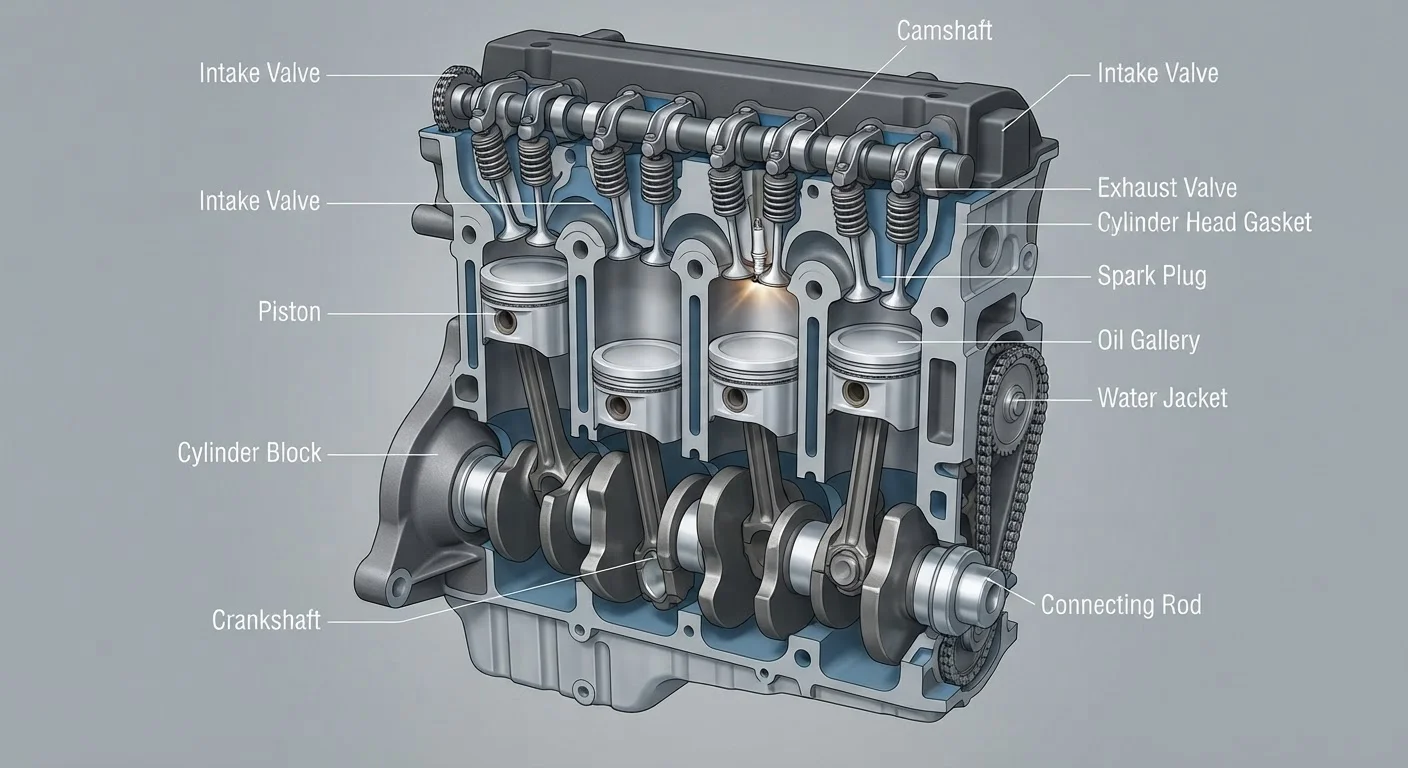
When a spec sheet lists a "2.0L" or "1998cc" engine, it is telling you the total volume that all the pistons sweep through in one complete up-and-down cycle. Picture each cylinder as a syringe: the piston pulls back to draw in an air-fuel mixture, then pushes forward to compress and ignite it. The volume displaced during that pull-back stroke is what gets measured - and the numbers from every cylinder are added together to produce the total displacement figure.
The litre and cubic centimetre figures are interchangeable: 1 litre equals exactly 1,000cc, so a 1,998cc engine is simply marketed as 2.0L. Manufacturers round to the nearest tenth of a litre for advertising, but the precise cc figure sometimes appears on registration documents or insurance paperwork. Neither number is more accurate - they are just different units for the same measurement.
For a broader look at how displacement fits alongside other powertrain figures, our powertrain terminology reference defines the full set of specs you are likely to encounter on a window sticker.
What Displacement Actually Tells You as a Driver
Displacement gives you a rough sense of an engine's breathing capacity - its ability to pull in air and fuel. More volume per cycle generally translates to more torque, which is the pulling and pushing force you feel when accelerating from a stop or climbing a grade. That is why large-displacement V8 engines remain common in trucks designed for heavy towing: sheer cylinder volume makes it easier to produce high torque at low engine speeds without straining the motor.
For everyday commuting, displacement influences how hard the engine has to work to maintain highway speeds. A 1.4L engine hauling a fully loaded minivan will operate near the top of its comfortable range, while a 3.5L engine in the same vehicle barely breaks a sweat. That difference shows up in long-term wear, heat, and the sense of confidence - or lack of it - when passing on a two-lane road.
1,000cc
Cubic centimetres equal to one litre
This conversion is standard across the automotive industry, explaining why a '2.0L' engine may be listed as '1,998cc' on official documents.
~30%
Average engine displacement reduction since 2000
Industry analysts have observed that widespread adoption of turbocharging has allowed manufacturers to significantly downsize average engine displacement while maintaining or increasing power outputs across many segments.
4-16
Typical cylinder count range in consumer vehicles
Displacement is spread across all cylinders; a 2.0L four-cylinder has roughly 500cc per cylinder, while a 4.0L eight-cylinder also has about 500cc per cylinder - demonstrating that total displacement is a product of both cylinder size and count.
That said, displacement is not a reliable standalone predictor of fuel economy or performance. Always read it alongside the torque and horsepower figures. Reading a car's performance spec sheet explains how those numbers interact in practice.
Why Turbocharged Engines Complicate the Picture
For most of automotive history, displacement was a reliable shorthand for power. A 3.0L engine produced more output than a 2.0L, almost without exception. Turbocharging changed that relationship significantly. A turbocharger forces compressed air into the cylinders, effectively letting a small-displacement engine breathe like a larger one under load.
The result is that a 1.5L or 2.0L turbocharged engine can produce horsepower and torque figures that would once have required a 3.0L naturally aspirated unit - sometimes while returning better fuel economy under light driving conditions. This is why manufacturers have steadily downsized displacement over the past two decades without reducing the power on offer.
The trade-off is nuanced. Small turbocharged engines can consume fuel rapidly when the turbo is working hard - during sustained highway overtaking or towing, for instance. Fuel economy figures and what they leave out explains why official consumption ratings may not reflect that kind of real-world demand. Common assumptions about this topic are also addressed in our piece on engine performance myths that trip up car buyers.
How to Use Displacement When Comparing Vehicles
Think of displacement as context rather than a verdict. When comparing two vehicles with similar displacement - say, both 2.5L - look next at whether one is turbocharged, how their torque curves differ, and what the manufacturer's rated fuel economy is. Two engines of identical displacement can feel dramatically different to drive depending on those variables.
For buyers focused on towing or payload, a naturally aspirated larger-displacement engine can offer more predictable, sustained power delivery without the heat management demands of a heavily loaded turbo. For city and suburban drivers who rarely carry heavy loads, a smaller turbocharged engine often delivers adequate performance at lower running costs.
Displacement also tends to correlate with maintenance considerations: larger engines have more cylinders, which generally means more spark plugs, more engine oil capacity, and potentially higher service intervals costs. These are worth factoring into total ownership cost alongside purchase price and insurance.
When you sit with a spec sheet and see the litre figure, use it as a starting point - then look at the full picture of torque, power delivery, and how those specs match your typical driving demands.