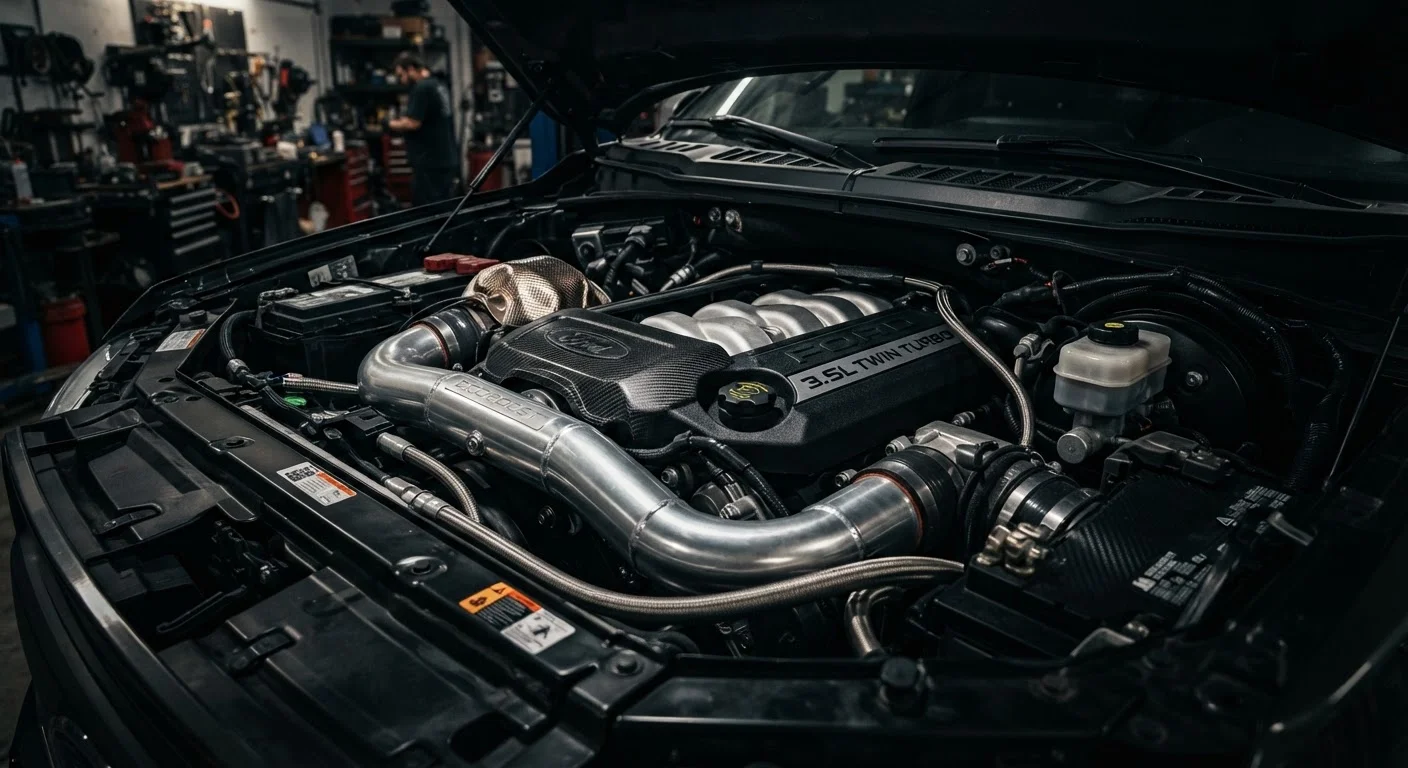
The Engine Lineup: What's Available in Half-Ton Trucks
Half-ton pickups - the Ford F-150, Chevrolet Silverado 1500, Ram 1500, and GMC Sierra 1500 among them - now offer buyers a choice that would have seemed implausible a decade ago: turbocharged four-cylinders, naturally aspirated V6s, V8s, inline-sixes, diesels, and mild-hybrid variants all coexist in the same segment. Understanding what each configuration actually delivers in daily use is essential before signing anything.
| Typical half-ton tow ratings (gas V8) | Up to ~13,000 lbs (configuration-dependent) (Manufacturer specs; ratings vary by cab, bed, axle ratio, and tow package) |
| Turbo 4-cylinder fuel economy advantage | 1-4 MPG better vs. V8 in light-load highway driving (EPA combined estimates; real-world gains narrow significantly under towing loads) |
| Diesel price premium (over base gas engine) | Typically $4,000-$6,000 at MSRP (General industry range; exact figures vary by manufacturer and trim) |
| Peak torque, light-duty diesel (typical) | ~480 lb-ft (Representative of current 3.0L half-ton diesel offerings) |
| DEF refill interval (diesel trucks) | Approximately every 5,000-10,000 miles (Varies by driving conditions and manufacturer specification) |
For a plain-language breakdown of terms like displacement, torque, and compression ratio, see the Powertrain Terminology reference - it covers the vocabulary used throughout this article.
Turbocharged Four-Cylinder: Efficiency With Trade-Offs
Automakers have introduced turbocharged four-cylinder engines into half-ton trucks primarily to improve EPA-rated fuel economy. Ford's 2.7-liter EcoBoost is a well-documented example: its twin-turbocharged design produces competitive horsepower and torque figures while returning better city fuel economy than comparably sized V8s under moderate loads.
The practical reality is more nuanced. Turbocharged engines generate peak torque at lower RPMs, which translates to strong initial throttle response and capable light towing. However, under sustained heavy loads - towing near maximum capacity on grades, for instance - smaller displacement engines work harder, which can affect both temperature management and long-term durability patterns depending on maintenance. Buyers who regularly tow at or near maximum ratings should weigh this carefully.
Fuel economy gains from four-cylinder engines are most pronounced in mixed or highway driving with light payloads. Under heavy towing, real-world economy often converges with that of larger engines.
V6 and V8 Engines: The Traditional Baseline
Naturally aspirated V6 engines typically serve as base or mid-tier options in half-ton trucks. They offer a lower purchase price, predictable power delivery, and a long track record in the segment. Towing and payload ratings vary by manufacturer and configuration, but V6s generally handle everyday hauling and moderate towing without strain.
The V8 remains the benchmark for buyers who prioritize maximum towing capacity, high-payload work, and the linear power delivery associated with larger displacement. V8s carry higher fuel costs but tend to operate with less thermal stress under sustained load compared to smaller turbocharged alternatives - a distinction relevant to commercial or frequent-tow use cases.
Some manufacturers have integrated mild-hybrid assistance (also called eMTS or e-assist depending on the brand) into their V8 offerings. This system captures braking energy to assist low-speed acceleration and support accessories, reducing fuel consumption modestly without requiring plug-in charging. For a deeper comparison of hybrid types, the Hybrid Powertrains Unpacked guide explains how mild, full, and plug-in systems differ.
Diesel in a Half-Ton: Range, Torque, and Cost
Light-duty diesel options - such as the Ram 1500's 3.0-liter turbodiesel - occupy a specific niche. Diesel engines produce high torque at low RPM, which is well-suited to towing heavy loads over long distances. They also deliver strong highway fuel economy, often outperforming gasoline equivalents by a meaningful margin on sustained highway runs.
The trade-offs are real: diesel trucks carry a significant purchase-price premium over gasoline counterparts, diesel fuel prices fluctuate independently of regular gasoline, and diesel emissions systems (DEF fluid, particulate filters) require periodic maintenance. Buyers who cover high annual mileage with frequent towing are the most likely to recoup those upfront costs over time. Occasional users rarely see a financial payoff.
Tow Ratings Depend on More Than the Engine
A truck's maximum tow rating is determined by its complete configuration - cab style, bed length, rear axle ratio, suspension, and tow package equipment all factor in. The engine is one variable among many. Always consult the truck's specific tow guide (published by the manufacturer) for the exact combination you're considering, rather than relying on a segment-wide headline number.
If you're deciding between a half-ton and a mid-size truck, the Mid-Size vs. Full-Size Pickup comparison addresses how capability, fuel economy, and costs scale with truck size.
Choosing the Right Engine for Your Actual Use Case
Engine selection should follow intended use - not spec-sheet maximums. A buyer who commutes daily and tows a small camper a few times a year has fundamentally different needs than one who pulls a 10,000-lb trailer weekly for a landscaping business.
- Light hauling and daily commuting: Turbocharged four-cylinder or base V6 options generally suffice and keep fuel costs lower.
- Moderate towing (5,000-8,000 lbs regularly): A V6, high-output turbocharged four, or V8 with appropriate towing package are all viable; prioritize the tow package equipment over raw engine size.
- Heavy, frequent towing near maximum ratings: A V8 or light-duty diesel offers thermal headroom and torque suited to the task, though the diesel requires a long-term cost calculation.
Once you've identified the powertrain that fits your workload, narrowing your shortlist to two or three real candidates becomes significantly more straightforward.