Why EV Myths Persist - and Why They Matter
Electric vehicles now represent a growing share of new car sales in the United States, yet a cluster of durable misconceptions continues to shape buyer decisions. Some myths originate from early EV limitations that no longer apply. Others reflect genuine nuances that get flattened into oversimplified talking points. A few are simply incorrect.
Sorting fact from fiction matters because the stakes are real: a vehicle purchase is one of the largest financial decisions most households make. Buyers who rely on inaccurate information risk either dismissing EVs unnecessarily or entering ownership with unrealistic expectations. For a grounded look at how EV ownership costs actually stack up, see our article on the real cost of owning an electric car over five years.
Below, we address the most widely repeated EV myths and explain what the evidence actually shows.
The Core Myths - Examined
The following myth-and-fact pairs cover the claims our editors hear most often from car buyers weighing an EV purchase. Each is grounded in publicly available research, engineering data, or documented real-world performance.
Myth
EVs produce more lifetime pollution than gasoline cars because manufacturing the battery is so carbon-intensive.
Fact
Studies consistently show that EV lifecycle emissions are lower than gasoline equivalents across most U.S. electricity grids, even accounting for battery production.
Battery manufacturing does carry a meaningful upfront carbon cost - primarily from mining and processing lithium, cobalt, and nickel. However, this "carbon debt" is typically offset within two to three years of average driving on the U.S. grid, according to research from institutions including the U.S. Department of Energy's Argonne National Laboratory.
As the electricity grid incorporates more renewable generation, that payback period shortens further. EVs charged predominantly on renewable energy have substantially lower lifetime emissions than any combustion vehicle. The manufacturing-phase emissions argument was more valid for early EVs with smaller batteries and dirtier grid mixes; it has weakened considerably as both battery technology and grid cleanliness have improved.
Myth
Cold weather makes EVs unreliable - range drops so severely in winter that they become impractical.
Fact
Cold temperatures do reduce EV range, typically by 20-40% in severe conditions, but modern thermal management systems and pre-conditioning features significantly mitigate the impact.
Lithium-ion batteries deliver less energy when cold, and cabin heating draws on the main battery pack rather than waste engine heat as in a gasoline car. These are real physics, not myths. However, the narrative that EVs become stranded in winter routinely overstates the severity.
Most contemporary EVs include battery thermal management that warms the pack before and during driving. Pre-conditioning - heating the cabin while still plugged in - preserves range on departure. Drivers who plan routes with a modest buffer and use available cold-weather features report manageable real-world impacts. Extreme cold in sub-zero Fahrenheit conditions remains a legitimate consideration for buyers in northern states, but it does not render EVs non-functional.
Myth
You need constant access to public charging, making EVs impractical unless you live near a fast-charger.
Fact
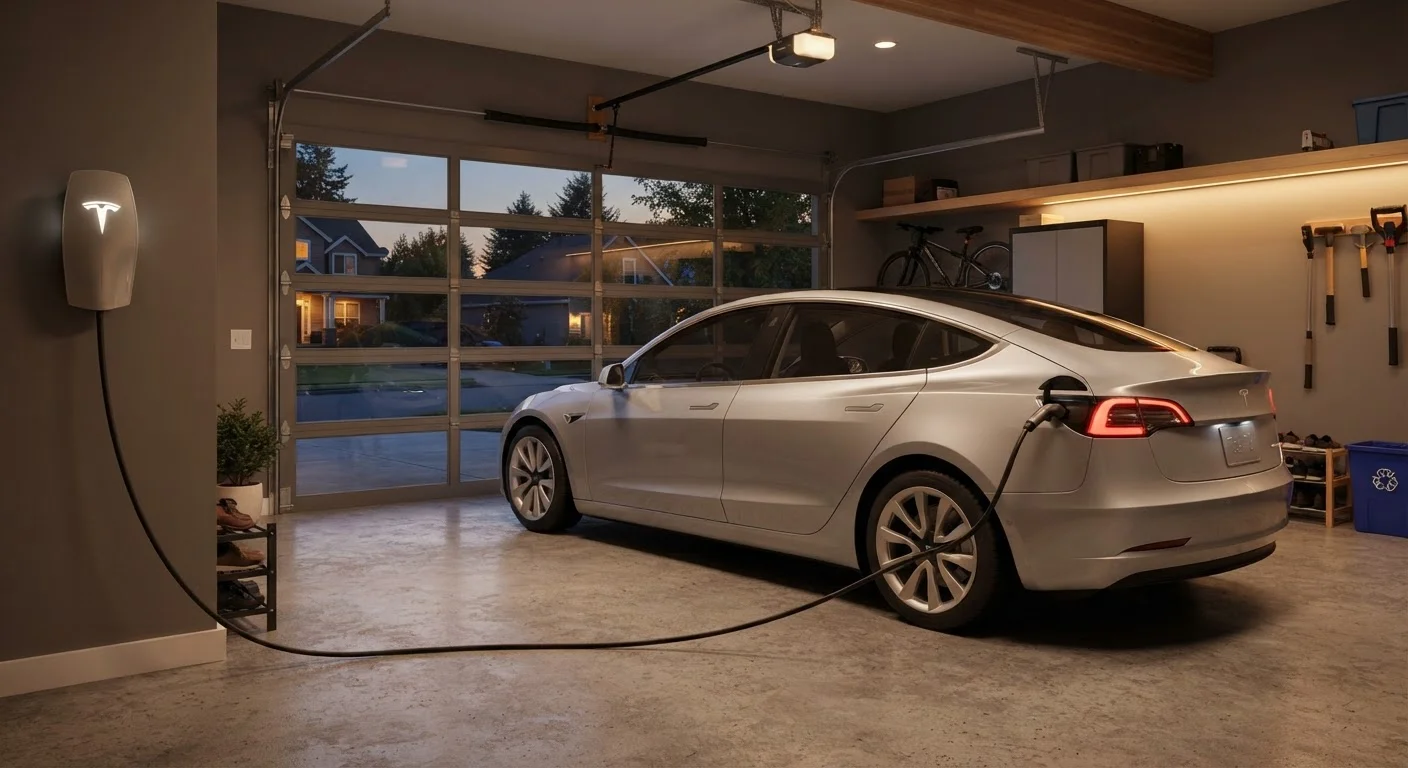
The vast majority of EV charging - estimated at roughly 80% by the U.S. Department of Energy - happens at home overnight, making daily public charging unnecessary for most drivers.
This myth conflates long-distance travel with everyday use. For the typical American commuter driving under 40 miles per day, a Level 2 home charger (240V) replenishes overnight what was used during the day. Drivers wake to a full charge every morning without visiting a charging station.
Public DC fast-charging matters most for road trips and for apartment or condo dwellers who lack home charging access. These are genuine challenges worth evaluating before purchase - but they affect a subset of buyers, not all of them. The public charging network has also expanded significantly in recent years, particularly along interstate corridors.
Myth
EVs are more expensive to own overall because electricity costs and battery replacement wipe out any fuel savings.
Fact
For most drivers, electricity costs less per mile than gasoline, and EV drivetrains have fewer moving parts, reducing routine maintenance expenses over time.
The per-mile cost of electricity is generally lower than gasoline for equivalent driving, though the margin varies by local utility rates and gasoline prices. EVs eliminate oil changes, have fewer brake wear issues due to regenerative braking, and have no transmission fluid, spark plugs, or timing belts to service.
Battery replacement is the most cited cost concern. Modern EV batteries are warranted by federal mandate for at least 8 years or 100,000 miles, and real-world data from high-mileage EVs suggests most packs retain substantial capacity well beyond warranty. Replacement costs have also declined as battery manufacturing has scaled. That said, total cost of ownership does depend on upfront price, financing terms, local electricity rates, and available incentives - variables that differ by buyer. See our five-year EV ownership cost breakdown for a structured comparison.
Myth
EV range ratings are reliable - if the window sticker says 300 miles, you'll get 300 miles.
Fact
EPA range estimates are testing benchmarks, not guarantees. Real-world range varies with speed, temperature, load, terrain, and driving style - sometimes significantly.
The EPA's range testing procedure uses a standardized laboratory cycle that does not replicate all real-world conditions simultaneously. Highway driving at 75-80 mph, cold ambient temperatures, heavy climate control use, and roof-rack cargo can each reduce range below the rated figure. Some independent testing organizations have documented real-world highway range 10-25% below EPA estimates on certain models.
This doesn't mean the EPA figure is useless - it provides a consistent basis for comparison between vehicles. But buyers should treat it as an upper bound under favorable conditions rather than a guaranteed minimum. Our editorial guide on how to read an EV review without getting misled explains which testing conditions to look for when evaluating range claims.
Understanding how official range figures are calculated is its own subject. Our guide on EV range and what official numbers don't tell you walks through the gap between EPA estimates and real-world results.
Putting the Myths in Context
No vehicle technology is without trade-offs, and EVs are no exception. Range loss in cold weather is real, even if manageable. Upfront purchase prices remain higher than many gasoline equivalents at comparable trim levels. Public charging infrastructure is still uneven across rural areas. Buyers who enter EV ownership aware of these realities tend to be far more satisfied than those chasing an idealized picture.
At the same time, several of the sharpest criticisms directed at EVs rely on outdated data or worst-case assumptions. Battery chemistry, thermal management systems, and charging networks have all improved substantially over the past decade.
If you're still weighing whether an EV fits your lifestyle - not just your values - our editorial team's assessment at where EV buyers' expectations go wrong offers a candid look at the mismatches that catch new owners off guard. And when you're ready to move forward, the complete walkthrough for first-time EV buyers covers every practical step from assessing your charging situation to finalizing a purchase.
~80%
EV charging that occurs at home
According to the U.S. Department of Energy, approximately 80% of electric vehicle charging takes place at residential locations.
8 yrs / 100K mi
Federal EV battery warranty minimum
U.S. federal regulations require automakers to warrant EV battery packs for at least 8 years or 100,000 miles, whichever comes first.
20-40%
Typical range reduction in severe cold
Independent testing and DOE research indicate range can decline by roughly 20-40% in sub-freezing temperatures, depending on the model and conditions.