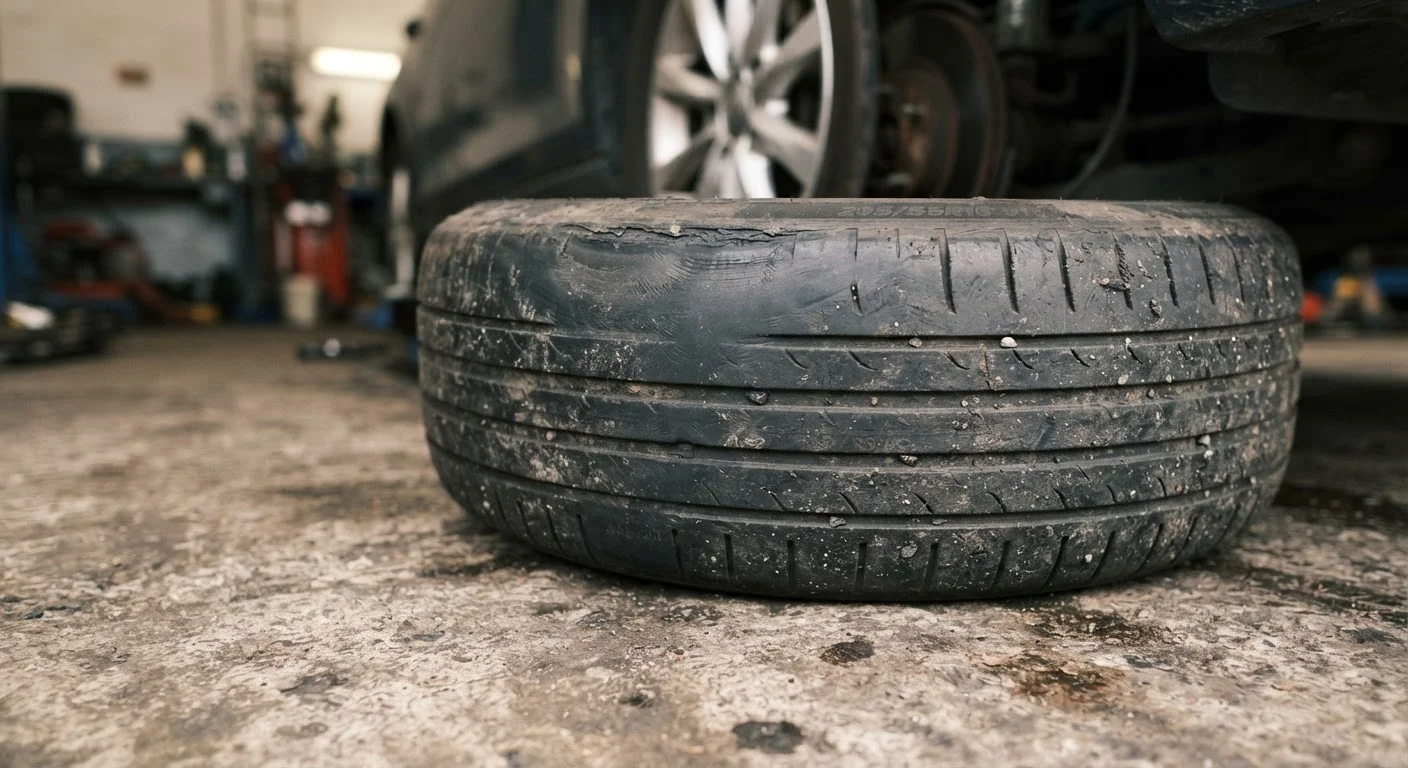
Why Tyres Are a Diagnostic Tool, Not Just a Safety Item
When evaluating a used car, most buyers check the paint, test the air conditioning, and glance at the odometer. Tyres rarely get the same scrutiny — but they should. Rubber degrades and deforms in ways that directly reflect how a vehicle has been driven, maintained, and repaired.
Tyres interact with alignment geometry, suspension components, brake systems, and inflation history simultaneously. Problems in any of those areas leave measurable marks on tread surfaces. Learning to read those marks gives you a concrete, physical record of how the car was treated — one that can't be altered the way paperwork sometimes can. See our guide to vehicle warning signs for a broader framework on spotting deferred maintenance before you buy.
Reading Wear Patterns: What Each Type Tells You
Not all tyre wear looks the same, and the pattern matters more than the depth alone.
- Center wear (middle worn, edges fine): Chronic overinflation. The tyre bulges at the center, which carries most of the load. This is generally a minor maintenance issue, but consistent overinflation can stress sidewalls over time.
- Edge wear (shoulders worn, center fine): Consistent underinflation. The tyre flattens under load, putting pressure on the outer edges. Prolonged underinflation generates heat and can cause internal structural damage not visible on the surface.
- One-sided wear (inner or outer edge only): The clearest sign of an alignment problem. Camber — the angle at which the tyre sits relative to vertical — is out of specification. This can indicate worn suspension components, bent steering parts, or an unresolved issue after a collision.
- Cupping or scalloping (wavy, uneven patches): Points to worn or failing shock absorbers or struts. The tyre bounces instead of maintaining steady contact with the road, creating irregular wear. This is a meaningful mechanical red flag.
- Flat spots: Often caused by hard braking or a vehicle sitting stationary for an extended period. Flat spots on a car with moderate mileage may suggest the car sat unused — which can also mean aged brake fluid, stale fuel, and dried rubber seals elsewhere.
Cross-reference any wear pattern you find with the explanation of rotation, balancing, and alignment to understand what corrective service should have been performed — and whether it was.
Tread Depth, Tyre Age, and Mileage Consistency
Tread depth is the most straightforward measure of remaining tyre life. U.S. law requires a minimum of 2/32 of an inch in most states; many safety organizations recommend replacing tyres at 4/32 for adequate wet-weather grip. A quarter coin inserted into the tread groove with the top of the head facing down — if you can see the full top of the head, the tread is at or below 4/32. A penny at the same depth reveals 2/32.
Tyre age matters independently of tread depth. The DOT date code stamped on every tyre sidewall ends in a four-digit number: the first two digits are the week of manufacture, the last two are the year. A tyre made in week 24 of 2018 reads 2418. Most manufacturers and safety authorities recommend replacing tyres after six to ten years regardless of tread depth, because rubber compounds degrade with UV exposure, heat cycles, and oxidation.
Here's where the detective work comes in: if a vehicle has 40,000 miles on it and all four tyres are still the originals from 2019 with significant tread remaining, that's plausible. But if a 2020 car with 15,000 miles has fresh tyres installed in 2023, ask why. A full set replaced at low mileage can indicate a collision, severe road damage, or an attempt to refresh the car's appearance before sale. Similarly, mismatched brands across axles — particularly front-to-rear — suggest tyres were replaced individually in response to failures rather than as a planned maintenance set, which is a sign of reactive rather than proactive ownership. For more on how mileage and physical condition should be interpreted together, see how to weigh up a used car's real value.
Practical Steps Before and During Your Inspection
After the visual inspection, verify your findings. Ask the seller for any tyre-related service records. Request a vehicle history report and check for collision claims — even minor ones can affect alignment. And always have a pre-purchase inspection performed by an independent, qualified mechanic who will put the car on a lift, check suspension components, and measure alignment angles directly.
For ongoing reference once you've bought a vehicle, the monthly tyre pressure and tread depth inspection routine provides a repeatable process for catching problems before they worsen.
This article is for general informational purposes only. Tyre and vehicle safety assessments should be confirmed by a qualified automotive technician. Do not rely solely on a visual inspection to determine vehicle roadworthiness.