Why Documents Matter Before You Buy
A used car's physical condition tells only part of the story. Paperwork fills in the gaps — previous ownership chains, collision repairs, lapsed maintenance, open safety recalls, and lien obligations that could follow the vehicle into your name. Missing or altered documents are among the most reliable red flags a buyer can encounter. Before visiting any seller, know which records to request and what each one should tell you.
This guide functions as a lookup reference: find the document type, understand what it reveals, and know what inconsistencies to watch for. For a full evaluation framework, see the pre-purchase inspection checklist that covers paperwork alongside mechanical checks.
Core Ownership and Title Documents
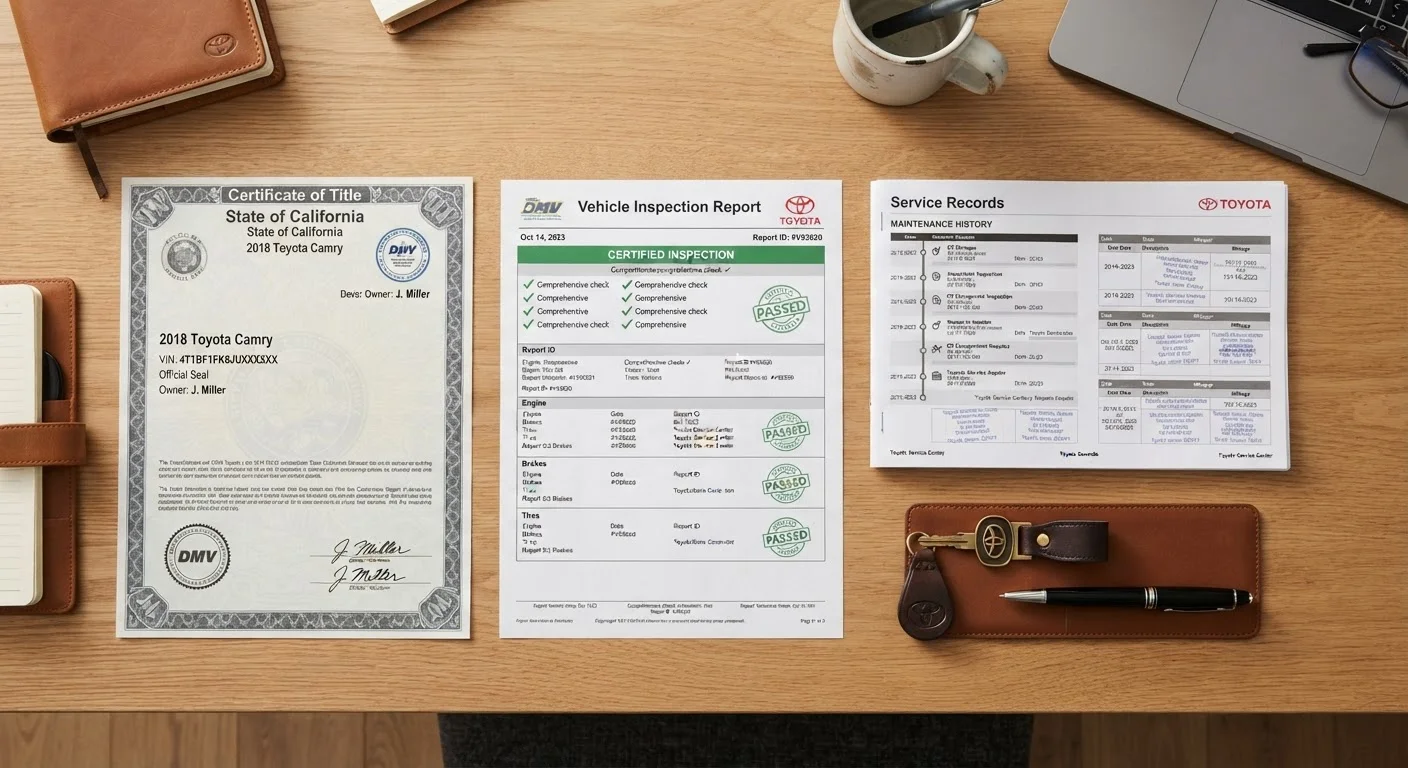
Certificate of Title (Vehicle Title) — The title is the foundational ownership document. Confirm the seller's name matches the title exactly. Check the title type: a clean title indicates no major reported damage; a salvage title means the vehicle was previously declared a total loss by an insurer. Rebuilt or reconstructed titles indicate a salvage vehicle that has since been repaired and reinspected — resale value and insurability are typically affected. Never complete a purchase without a signed, lien-free title in hand.
Lien Release Documentation — If a lender previously financed the car, confirm the lien has been satisfied. A title showing a lienholder that hasn't been released means the seller may not have clear legal right to transfer ownership. Request written lien release documentation or confirm directly with the lender before funds change hands.
Odometer Disclosure Statement — Federal law requires sellers to provide a written odometer disclosure at the time of sale for most vehicles under ten years old. The mileage on this statement should match the dashboard reading and the vehicle history report. Discrepancies warrant immediate scrutiny.
Clean Title
A vehicle title with no recorded damage brands, meaning no insurer has declared the car a total loss. It does not guarantee the car has never been in an accident — only that no major claim triggered a title brand.
Salvage Title
Issued when an insurer declares a vehicle a total loss, typically because repair costs exceed a threshold percentage of the car's value. Salvage-titled vehicles are generally not road-legal until inspected and retitled.
Lien
A legal claim a lender holds on a vehicle used as collateral for a loan. A lien must be released before a seller can legally transfer a clear title to a buyer.
VIN (Vehicle Identification Number)
A unique 17-character code assigned to every motor vehicle at manufacture. Used to look up history reports, recall status, and title records specific to that vehicle.
Odometer Disclosure
A written statement, required by federal law, certifying the mileage reading at the time of sale. Intentional misrepresentation is a federal offense.
Rebuilt/Reconstructed Title
A title brand applied to a formerly salvage vehicle that has been repaired and passed a state inspection to return to the road. Resale value and insurance availability are often reduced compared to a clean-title vehicle.
History, Maintenance, and Recall Records
Vehicle History Report — Third-party history reports aggregate data from insurers, auctions, DMVs, and repair facilities. They can surface accident records, title brands, flood damage flags, and ownership counts. No report is guaranteed to be exhaustive — unreported incidents won't appear — but a clean report combined with consistent seller documentation is meaningfully reassuring.
Service and Maintenance Records — A logbook, dealer printout, or folder of receipts showing oil changes, tire rotations, timing belt replacements, and other scheduled work demonstrates how the car was maintained. Gaps in service history — especially around high-mileage intervals — are worth discussing with the seller. Consistent records from a single shop add credibility.
Open Recall Check — Use the vehicle's 17-character VIN (Vehicle Identification Number) to search the National Highway Traffic Safety Administration (NHTSA) database for any open safety recalls. Recalls are repaired at no cost to the owner at authorized dealers, but only if the work has been completed. A car with an open recall isn't automatically disqualifying — confirm whether the repair has been done and get documentation if it has.
Emissions and Safety Inspection Certificates — Requirements vary by state. Some states mandate annual inspections; others don't. Where applicable, request the most recent inspection certificate and verify it is current. An expired inspection can signal deferred maintenance. For a broader view of what to check in person, see what to inspect before buying a used car.
1 in 4
Used vehicles with a significant history event
Vehicle history data providers have estimated roughly one in four used cars carries a reported accident, title brand, or odometer anomaly.
~49M
Vehicles with open recalls on U.S. roads
NHTSA has reported tens of millions of vehicles on American roads at any given time carry at least one unaddressed safety recall.
10 years
Federal odometer disclosure threshold
Under the Truth in Mileage Act, written odometer disclosure is required for most vehicle transfers involving cars fewer than ten model years old.
Repair Records and Warranty Documentation
Collision and Major Repair Receipts — If the vehicle history report flags an accident, ask for the body shop estimate and repair invoice. These reveal the scope of damage and whether OEM (original equipment manufacturer) or aftermarket parts were used. Repairs using non-OEM parts can affect fit, finish, and sometimes structural integrity.
Remaining Manufacturer or Extended Warranty — Some vehicles are still within the original manufacturer's powertrain or bumper-to-bumper warranty window; others carry a transferable extended warranty purchased by a prior owner. Request the warranty contract and confirm transferability terms, coverage limits, and deductible amounts directly with the issuing company. Verbal assurances are not sufficient.
Bill of Sale from Prior Transactions — Prior bills of sale help verify the ownership timeline and sale prices. They can also surface inconsistencies — for example, a car sold multiple times in a short window or across distant states may warrant additional scrutiny.
Gathering these documents before agreeing to a price puts you in a far stronger position to evaluate the deal on its actual merits. For guidance on the full buying process from first search through final paperwork, see the complete roadmap to finding and buying a used car.
This article provides general informational guidance only and is not legal or financial advice. For decisions involving significant financial or legal implications, consult a qualified professional.