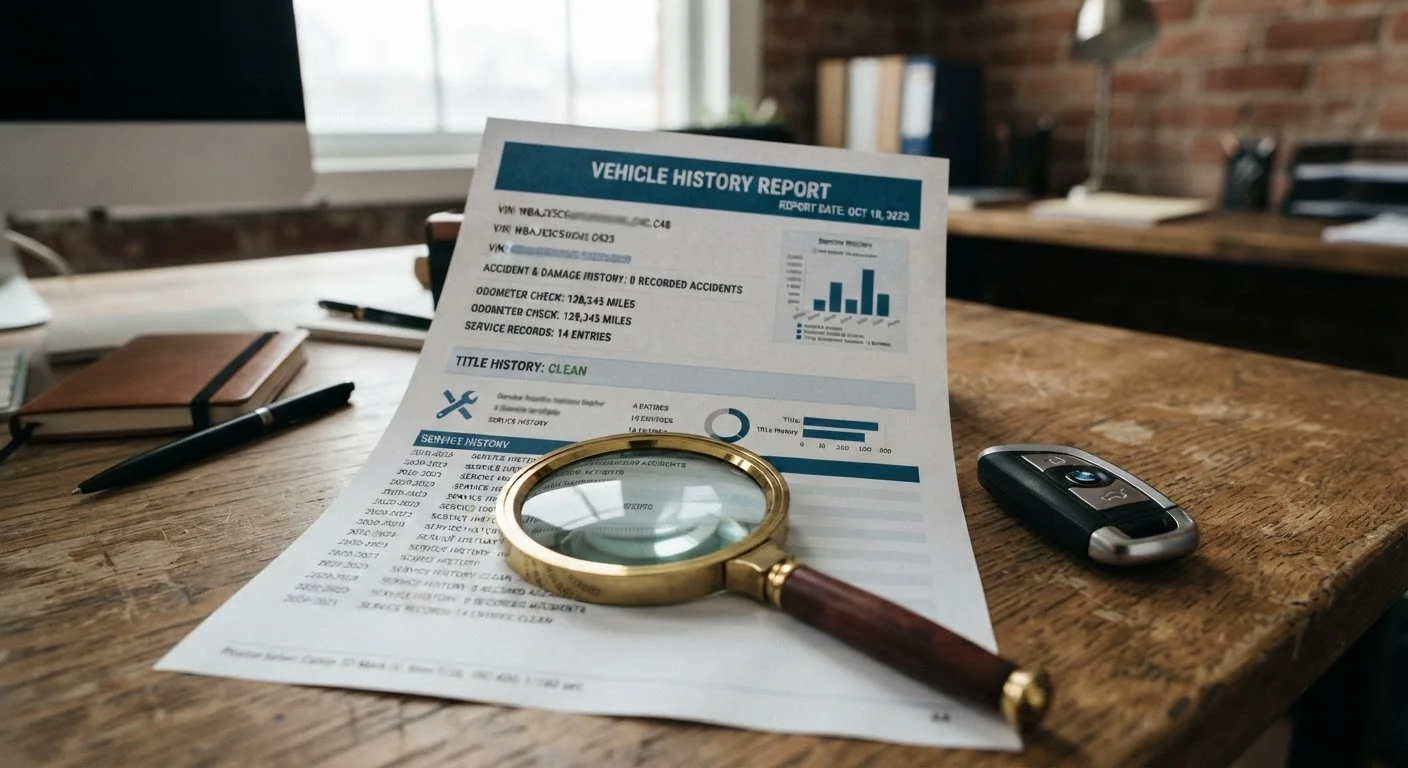
What Vehicle History Reports Actually Cover
A vehicle history report (commonly associated with services that aggregate data from state DMVs, insurance companies, and auto auctions) compiles officially reported events tied to a vehicle's VIN. What it reliably captures includes:
- Title records: Ownership transfers, title brands (salvage, rebuilt, flood, lemon law buyback), and state of registration.
- Odometer disclosures: Readings recorded at sale or inspection milestones, flagging potential rollback.
- Reported accidents: Collisions reported to insurers or police that generated a data record.
- Auction and fleet history: Whether the vehicle cycled through rental fleets, government use, or dealer auctions.
- Recall status: Open or completed manufacturer safety recalls tied to that VIN.
For a deeper breakdown of each section, see reading each section of a vehicle history report.
Myth
A clean vehicle history report means the car has never been in an accident.
Fact
A clean report means no accident was officially reported through a channel that feeds the data aggregator — not that no accident occurred.
Most minor collisions are settled without insurance claims or police involvement. A report is built from data contributors — insurers, state agencies, auctions — and a collision that bypassed all of them simply won't appear. Body shops that don't report to data networks, private settlements, and out-of-state incidents frequently fall through the cracks.
Myth
If the report shows a one-owner history, the car was well cared for.
Fact
Ownership count says nothing about how the vehicle was driven, maintained, or stored.
A single owner who rarely serviced the car, drove it hard, or stored it in harsh conditions can leave the vehicle in worse mechanical shape than one that passed through multiple careful hands. Ownership count is a provenance indicator, not a proxy for condition or maintenance quality.
Myth
The mileage on the report confirms the odometer reading is accurate.
Fact
Odometer readings in the report are periodic snapshots and may not reflect the current actual mileage.
Readings are logged only at specific events — inspections, title transfers, auction entries. Between those points, actual miles accumulate without record. A report can show consistent readings up to a certain date while the current odometer reflects significantly more use since the last recorded event. Always compare the report's most recent reading against the dashboard and watch for gaps in the timeline.
Myth
A salvage title always means the car is dangerous and should be avoided.
Fact
A salvage title signals significant prior damage and warrants extra scrutiny, but the risk level depends on the quality of the repair work.
A salvage brand is assigned when an insurer declares the vehicle a total loss — typically when repair costs exceed a threshold of its value. Some salvage-titled vehicles are professionally rebuilt and inspected; others are patched together poorly. The concern is that repair quality is difficult to verify without a thorough inspection by a structural damage specialist. Rebuilt salvage titles carry higher insurance costs and lower resale value, and financing can be difficult to obtain — these are practical factors to weigh, not just safety concerns.
Myth
If the report shows regular service entries, the car is mechanically reliable.
Fact
Service entries in a report are limited to dealerships and shops that share data — most independent mechanics and DIY maintenance are invisible.
Many vehicles are serviced entirely at independent shops or by their owners without generating any data record. A sparse service history on the report may reflect a car maintained outside reporting channels rather than a neglected one. Conversely, a car serviced at a reporting dealer generates visible entries — but those entries only confirm the work was performed, not that all necessary maintenance was addressed. Physical records and receipts remain the most complete picture.
The Gaps That Catch Buyers Off Guard
The report's most significant limitation is simple: it only knows what was reported. A fender-bender settled privately between two drivers, repaired at a body shop that doesn't report to insurers, and never filed with police generates no record. The car can carry a clean report while hiding thousands of dollars in prior damage.
Maintenance history is another major blind spot. Whether the previous owner changed the oil on schedule, replaced the timing chain at the recommended interval, or deferred critical repairs — none of that appears unless the work was done at a dealership that shares data with the aggregator. Independent shops, DIY maintenance, and most regional chains do not contribute records.
Don't Let a Clean Report Skip the Inspection
A vehicle history report with no flags is not a pass/fail certification — it is a partial record. Skipping a pre-purchase mechanical inspection based on a clean report is one of the most common and costly mistakes used car buyers make. Budget for a qualified independent mechanic to inspect the vehicle before any deposit or contract is signed.
Finally, condition is entirely absent. A report cannot tell you whether the interior is worn, the tires are near the wear bars, or the suspension bushings are deteriorating. That requires physical examination.
To understand what a verified service history can add — and how to read one — see decoding a used car's service history.
How to Fill the Gaps Before You Buy
Use the report as a filter, not a final verdict. A salvage title, flood brand, or odometer flag is a genuine red flag worth walking away from. But a clean report should trigger confidence only in what it measured — not in the car overall.
- Commission a pre-purchase inspection (PPI): A qualified independent mechanic can identify structural damage, deferred maintenance, fluid conditions, and wear items the report cannot see. This is the single most effective gap-filler available to used car buyers.
- Request maintenance records: Ask the seller for receipts, service booklets, or dealer records. Gaps in documentation are themselves informative — understanding what gaps in the data mean can help you interpret what's missing.
- Cross-check the listing: Inconsistencies between the report (prior states, ownership count, accident notation) and the seller's description are worth probing. evaluating a used car listing before you visit explains what to look for before you even make contact.
- Test drive the vehicle: Mechanical symptoms — transmission hesitation, brake pulsation, pulling under acceleration — surface during a thorough drive and won't appear on any report.
This article provides general educational information about vehicle history reports. It is not a substitute for professional mechanical inspection or legal advice specific to your purchase situation.