Why Tyre Pressure Quietly Does So Much
Most drivers accept that tyres need occasional attention — but tyre pressure rarely gets the focused consideration it deserves. Unlike a flat tyre or a worn tread, incorrect inflation is invisible. A tyre can be 8–10 PSI below its recommended level and still look perfectly normal at a glance. That gap between appearance and reality is exactly why pressure is one of the most consistently neglected aspects of routine vehicle upkeep.
Tyre pressure is the foundation of how your tyres perform. The correct inflation level maintains the right contact patch — the small area of rubber actually touching the road — which determines braking efficiency, steering response, and load-carrying ability. When pressure deviates in either direction, each of those functions degrades in ways that compound over time.
Understanding pressure also matters when evaluating a used vehicle. Tyre condition can reveal a great deal about a car's maintenance history, and uneven wear patterns are often a direct signature of chronic pressure mismanagement.
Underinflation vs. Overinflation: Two Different Problems
Both conditions are harmful, but they create distinct failure modes worth understanding separately.
Underinflation
When a tyre is underinflated, more of the tyre's sidewall flexes with every revolution. That excess flexing generates heat — and heat is the primary cause of tyre failure. Underinflated tyres wear faster on both outer edges, reduce fuel economy because the engine must work harder against increased rolling resistance, and lengthen braking distances. In severe cases, they increase blowout risk, particularly at highway speeds.
Overinflation
An overinflated tyre becomes rigid and less able to absorb road irregularities. The contact patch narrows, meaning less rubber is gripping the road at any given moment. This reduces traction, makes the ride harsher, and causes accelerated wear concentrated in the centre of the tread. An overinflated tyre is also more vulnerable to sudden damage from potholes or debris because there is less give in the structure to absorb impact.
~1 PSI
Monthly pressure loss in a healthy tyre
Tyres naturally lose approximately 1 PSI per month through normal permeation, according to tyre industry guidance — making monthly checks a practical minimum.
25%
Pressure drop before TPMS alerts trigger
The U.S. federal TPMS standard requires a warning when pressure drops to 25% below the vehicle manufacturer's recommended level — meaning significant underinflation can go undetected.
Up to 0.3%
Fuel economy loss per 1 PSI underinflation
The U.S. Department of Energy has noted that fuel economy can drop by approximately 0.2–0.3% for every 1 PSI drop in average tyre pressure across all four tyres.
Finding the Right Pressure — and Checking It Properly
The target pressure for your vehicle is printed on a sticker typically located on the driver's side door jamb or, on some models, inside the fuel filler flap. This figure is vehicle-specific and accounts for weight distribution, suspension design, and intended use. The number moulded onto the tyre sidewall itself is the maximum rated pressure for the tyre — not the recommended inflation for your car. Using the sidewall figure as your target is a common mistake that leads to chronic overinflation.
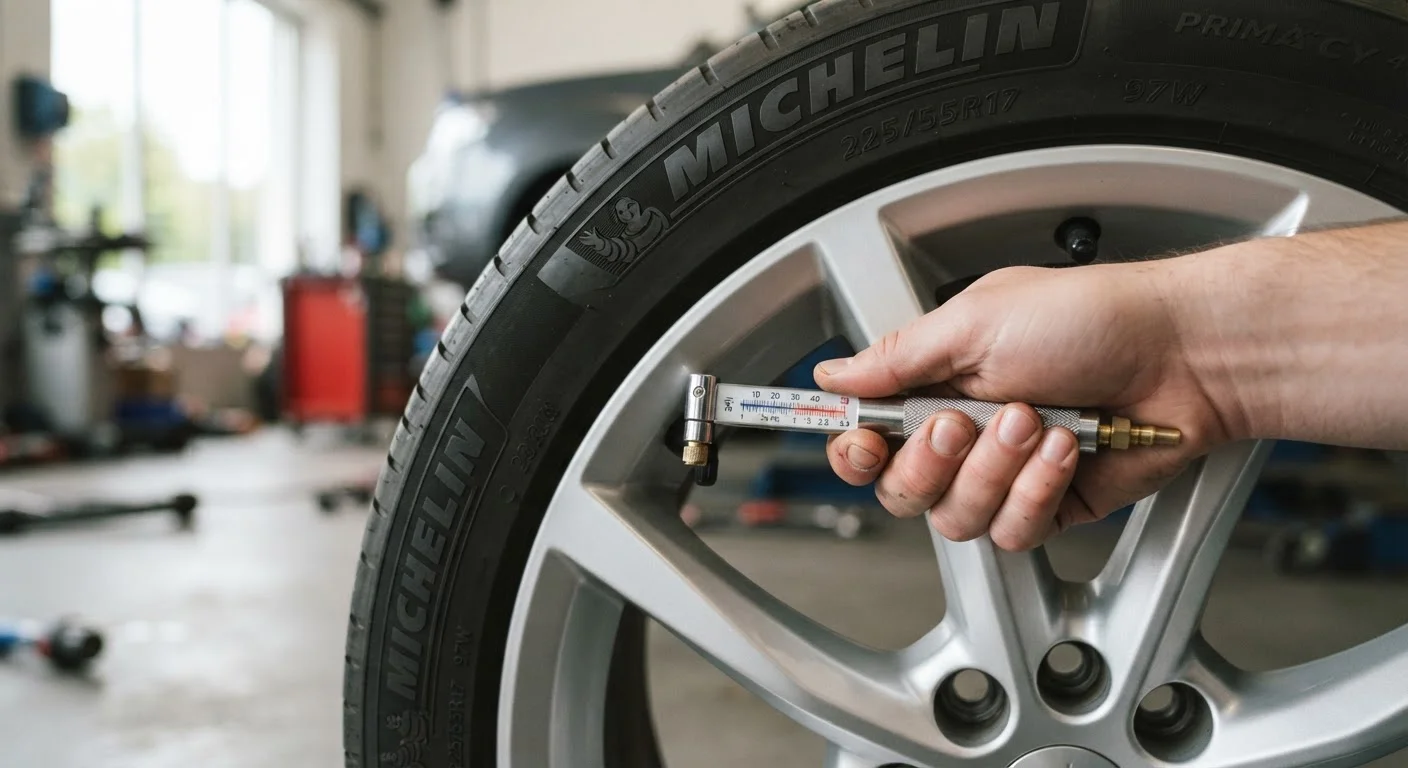
To check pressure accurately, use a quality gauge when tyres are cold — meaning the vehicle has been parked for at least three hours or driven fewer than one mile. Driving heats the air inside tyres, which temporarily raises the reading. Check all four tyres and the spare if your vehicle carries one. For a detailed walkthrough of the full inspection process, see this monthly tyre inspection routine.
Temperature, Seasons, and the TPMS Limitation
Tyre pressure is not static. Air contracts in cold temperatures and expands in heat, meaning pressure fluctuates with the seasons and even between morning and afternoon. As a general principle, for every 10°F (approximately 5.6°C) change in ambient temperature, tyre pressure shifts by roughly 1 PSI. This makes autumn and winter the periods when underinflation is most likely to sneak up on drivers who don't check regularly.
Many modern vehicles include a Tyre Pressure Monitoring System (TPMS), which illuminates a dashboard warning when pressure drops significantly below the recommended level. While TPMS is a useful safety net, it is not a substitute for manual checks. Most systems are designed to trigger alerts only when a tyre is approximately 25% below the recommended pressure — a threshold at which real performance degradation is already well underway. Regular manual checks with a gauge catch smaller deviations before they become problematic.
The broader safety picture extends beyond pressure alone. Pressure, tread depth, and grip work together to determine how effectively your car stops and steers — understanding all three gives a complete picture of tyre health. And for owners who want to understand the full scope of tyre services, rotation, balancing, and alignment each play a distinct role in maintaining even wear and safe handling.