What an Engine Air Filter Actually Does
Every internal combustion engine depends on a continuous supply of clean air. To produce power, fuel must combust — and combustion requires oxygen. Your engine pulls in large volumes of outside air with every cycle, and without filtration, that air carries dust, pollen, insects, and fine particulates straight into the cylinders.
The engine air filter acts as a barrier, trapping contaminants before they reach sensitive components like the MAF sensor, throttle body, and cylinder walls. A clean filter allows adequate airflow while keeping harmful particles out. Once it becomes saturated with debris, it starts doing both jobs poorly — restricting airflow and potentially allowing finer particles to slip through as filter media degrades.
To understand how air and fuel work together under the hood, the Performance & Drivetrain hub covers engine fundamentals in plain terms.
10,000:1
Air-to-fuel ratio by volume in a typical engine
Engines require roughly 10,000 gallons of air for every gallon of fuel burned, underscoring how critical clean, unrestricted airflow is to combustion.
15,000–30,000 mi
Typical engine air filter replacement interval
Most vehicle manufacturers specify this range in owner's manuals, though dusty driving conditions can shorten the effective service life significantly.
Up to 10%
Potential fuel economy loss from a clogged filter
Industry estimates suggest a severely restricted air filter can reduce fuel efficiency by as much as 10%, though results vary by vehicle and degree of restriction.
Signs Your Engine Air Filter Needs Attention
Filters don't fail all at once — performance degrades gradually, which is why many drivers don't notice until the problem has compounded. Watch for these indicators:
- Reduced acceleration: The engine feels sluggish or hesitates when you press the accelerator, particularly at highway speeds.
- Decreased fuel economy: You're filling up more often without a clear explanation, such as more city driving or carrying extra load.
- Rough idling or misfires: A restricted air supply disrupts the fuel-air mixture, which can cause the engine to idle unevenly or misfire under load.
- Check engine light: Fault codes related to the MAF sensor or air-fuel ratio are sometimes caused by a clogged filter affecting sensor readings.
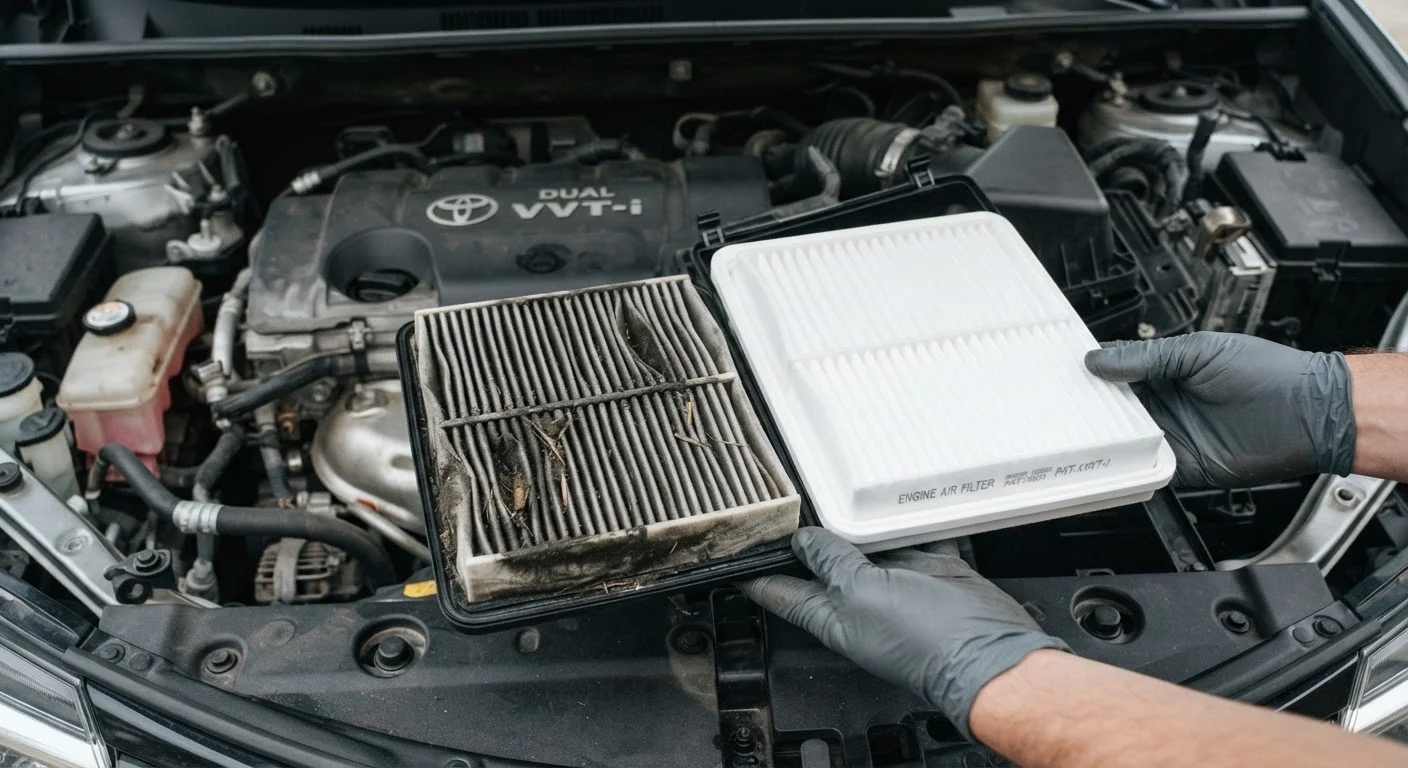
- Visible dirt on the filter: The simplest test — pull the filter out and hold it up to light. Heavy gray or brown discoloration across the entire filter surface is a clear signal it's due for replacement.
For context on how airflow-related components interact with engine performance, see our overview of oxygen sensors, MAF sensors, and other emissions-related parts.
Service Intervals and Driving Conditions
Manufacturer guidelines typically recommend replacing the engine air filter every 15,000 to 30,000 miles. Your owner's manual is the most reliable reference, as the interval varies by engine design and intended use.
Driving environment matters considerably. A filter used primarily on clean highway roads will last longer than one exposed to unpaved roads, construction zones, or high-pollen areas. If you frequently drive in these conditions, inspect the filter at every oil change rather than waiting for the mileage interval.
It's also worth distinguishing the engine air filter from the cabin air filter, which is a separate component serving a completely different purpose. Our article on how cabin and engine air filters each work explains the difference clearly.
Check Your Filter During Every Oil Change
The air filter housing is usually accessible in under a minute. Make it a habit to pull the filter and inspect it visually whenever your oil is changed. If it's heavily discolored across the entire surface, replace it — even if the mileage interval hasn't been reached. This is especially important for drivers in dusty or high-pollen regions.
Replacing the Filter: What to Expect
On most vehicles, the engine air filter is housed in a plastic box connected to the intake duct — usually located near the front of the engine bay. Replacing it typically involves unclipping or unscrewing the housing, removing the old filter, and inserting the correctly sized replacement with the same orientation.
Before doing this yourself, confirm you have the right filter for your vehicle's year, make, and model — the part number is usually printed on the existing filter or listed in your owner's manual. If you're uncomfortable accessing the housing or the intake system in your vehicle is less straightforward, a mechanic can handle the swap during a routine service visit.
Keeping up with small maintenance tasks like this one helps avoid larger, more costly issues down the road — a theme explored further in our article on why coolant flushes matter more than drivers often assume.
This article is for general informational purposes only. Always consult your vehicle's owner's manual and a qualified mechanic before performing maintenance or repair work on your vehicle.