What These Parts Actually Do
Your vehicle's emissions control system is a network of sensors, valves, and chemical converters working together to reduce the pollutants your engine produces. Understanding each part makes it far easier to interpret a warning light or a repair estimate.
| Typical O2 Sensor Lifespan | 60,000–100,000 miles (unheated designs wear sooner) (General industry service guidance) |
| MAF Sensor Location | Between the air filter housing and throttle body |
| Catalytic Converter Warranty | Federally mandated 8 years / 80,000 miles on emissions components (U.S. EPA emissions warranty requirements) |
| Common Failure Trigger | Check Engine light (MIL) with a P0xxx or P04xx fault code |
| EVAP Leak Detection | Smoke test performed by a technician using pressurized inert gas (Standard shop diagnostic procedure) |
| EGR Valve Cleaning Interval | No universal interval; inspect when fault codes appear (Varies by manufacturer and driving conditions) |
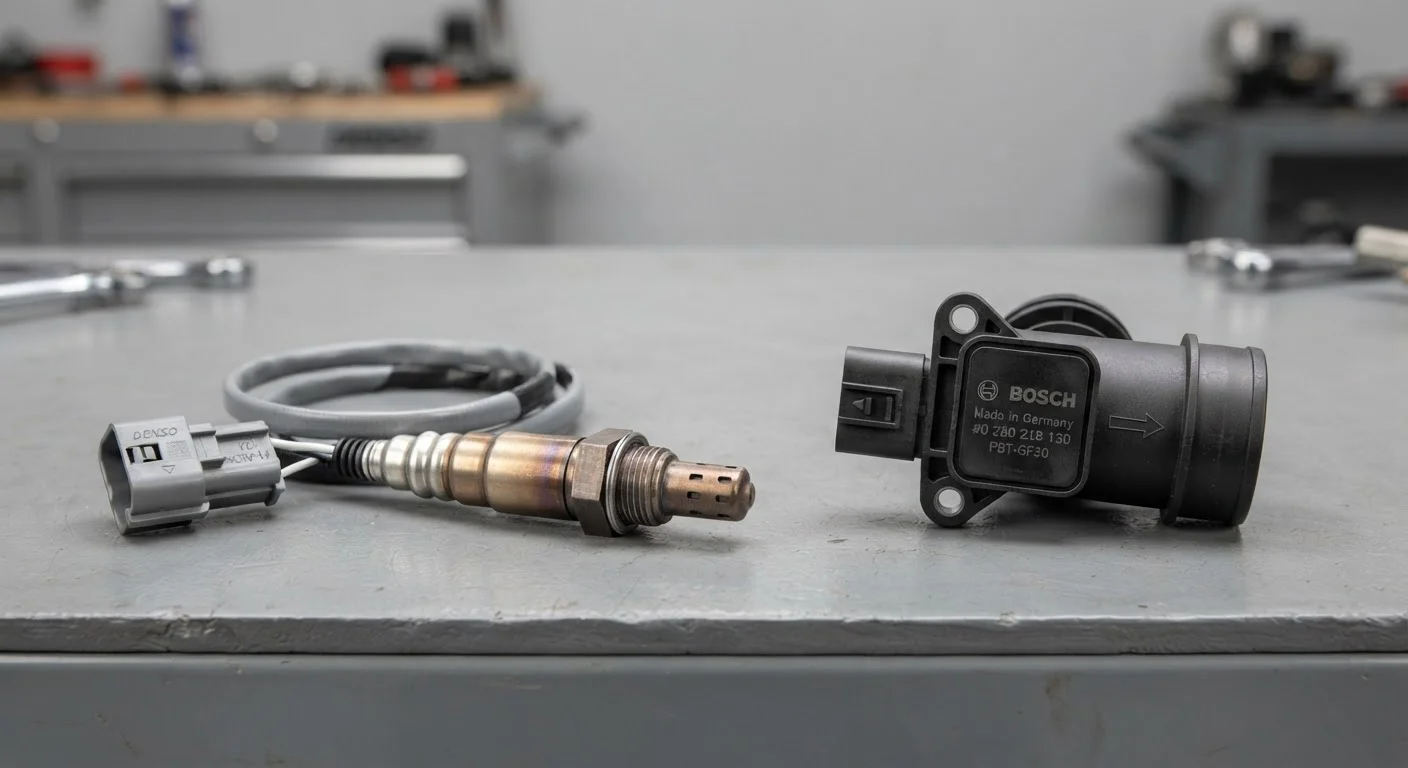
Oxygen sensors (O2 sensors) are the most frequently replaced emissions parts. An upstream sensor sits before the catalytic converter and continuously samples exhaust gases, sending voltage signals to the engine control module (ECM). The ECM uses that data to fine-tune the air-fuel ratio in real time. A downstream sensor, positioned after the converter, monitors how effectively the converter is doing its job — it's a quality-check sensor rather than a control sensor.
The mass airflow sensor (MAF) measures exactly how much air is entering the engine on every intake stroke. Because fuel injection quantity is calculated against incoming air volume, a dirty or failing MAF sensor throws off the entire combustion equation — leading to rough idle, hesitation, and poor fuel economy. The MAF sits just after the air filter, which is why a clean engine air filter is directly relevant to MAF sensor health.
The catalytic converter uses palladium, platinum, and rhodium to trigger chemical reactions that convert carbon monoxide, unburned hydrocarbons, and nitrogen oxides into carbon dioxide, nitrogen, and water vapor. It requires a properly tuned engine to reach its operating temperature quickly — a misfiring engine or rich-running condition can overheat and destroy a converter prematurely.
EGR Valves, EVAP Systems, and Why They Fail
Beyond the sensors and converter, two other subsystems generate a significant share of emissions-related repair work.
Oxygen Sensor (O2 Sensor)
A device mounted in the exhaust system that measures how much oxygen remains in the exhaust gases. The engine control module uses this data to adjust the air-fuel mixture for efficient combustion.
Mass Airflow Sensor (MAF)
A sensor located between the air filter and the throttle body that measures the volume and density of air entering the engine. This helps the computer calculate how much fuel to inject.
Catalytic Converter
An exhaust component containing precious metals that chemically convert harmful combustion byproducts — such as hydrocarbons and carbon monoxide — into less harmful substances before they exit the tailpipe.
EGR Valve
The Exhaust Gas Recirculation valve routes a measured amount of exhaust gas back into the intake manifold to lower combustion temperatures and reduce nitrogen oxide (NOx) emissions.
EVAP System
The Evaporative Emission Control system captures fuel vapors from the fuel tank and routes them into the engine to be burned, preventing them from escaping into the atmosphere.
Downstream O2 Sensor
An oxygen sensor positioned after the catalytic converter. Its primary role is to monitor converter efficiency rather than adjust the fuel mixture — it acts as a performance check on the catalytic converter.
The EGR (Exhaust Gas Recirculation) valve is prone to carbon buildup — especially on vehicles driven frequently on short trips where the engine never fully warms. A stuck-open EGR valve causes rough idle and stalling; a stuck-closed valve allows higher combustion temperatures, increasing NOx output and potentially triggering a check engine light. Cleaning or replacement restores proper operation, and the repair is often more straightforward than drivers expect.
The EVAP system is commonly misunderstood because its failure rarely affects how the vehicle drives. A loose or cracked gas cap is the single most frequent cause of an EVAP-related check engine light. More complex leaks — from the purge valve, vent solenoid, or charcoal canister — require a smoke test to locate. If your check engine light appears shortly after a fill-up, check the gas cap first before scheduling a diagnostic.
Common failure causes across all emissions components:
- Age and heat cycling (O2 sensors, catalytic converter)
- Contamination from oil burns or coolant leaks (MAF sensor, O2 sensor)
- Carbon accumulation from short-trip driving (EGR valve)
- Physical damage — road debris is a leading cause of catalytic converter failure
- Loose or degraded connections in wiring harnesses
When choosing replacement parts, it's worth understanding the difference between new, remanufactured, and rebuilt options. Our guide to remanufactured, rebuilt, and used parts explains what each label actually means for quality and warranty coverage.
This article provides general educational information about vehicle emissions components. For diagnosis, repair, or replacement of any emissions-related part, consult a qualified mechanic. Improper repairs may affect emissions compliance and vehicle safety.