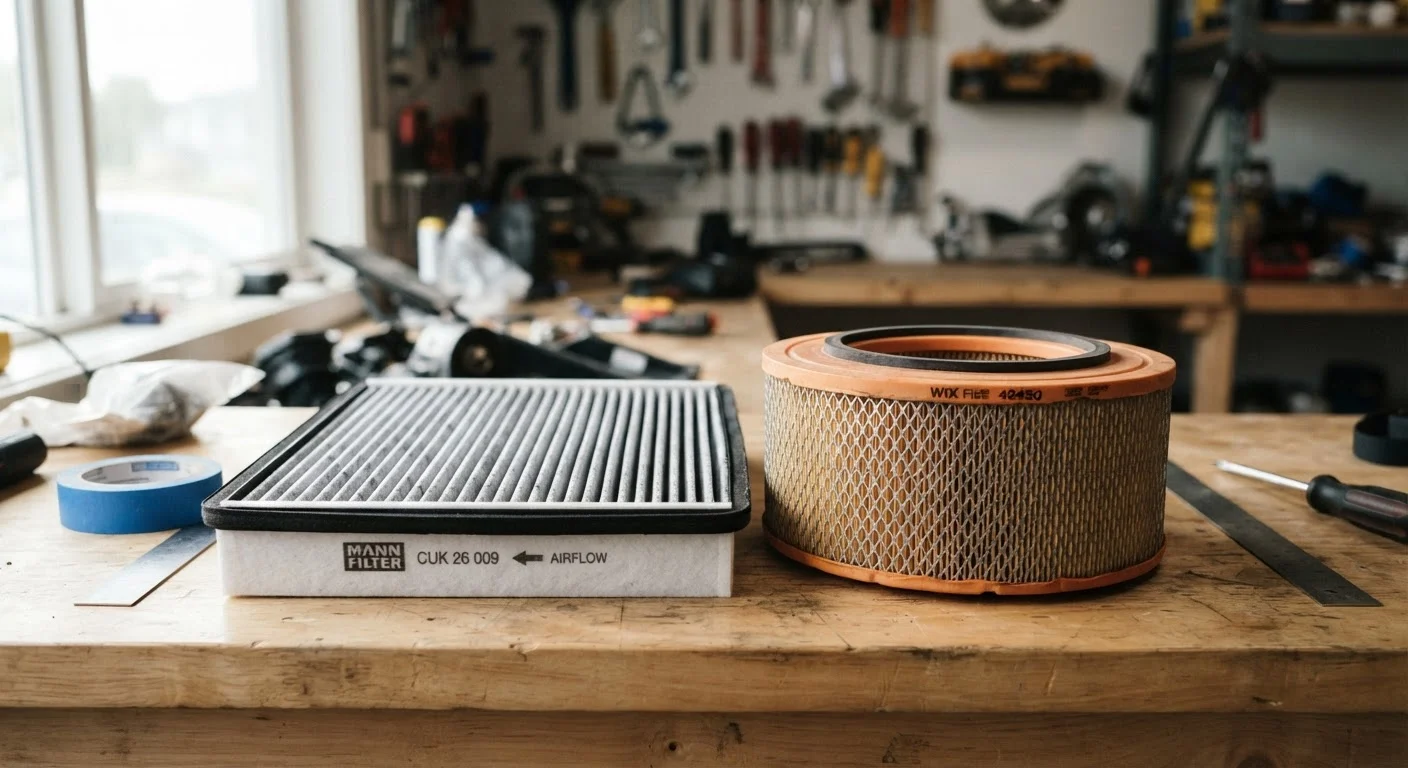
What Each Filter Actually Does
Despite sharing the word "filter" and the job of blocking airborne particles, these two components serve entirely separate systems inside your vehicle.
The cabin air filter sits in the HVAC (heating, ventilation, and air conditioning) system — usually behind the glove box, under the dashboard, or beneath a cowl panel near the base of the windshield. Every time you run the fan, defrost, or air conditioning, incoming air passes through this filter before it reaches the passenger compartment. Its job is to catch dust, pollen, mold spores, exhaust particles, and other airborne debris so they don't circulate around you and your passengers. For a deeper look at how the two filter types compare in operation, see this overview of cabin vs. engine air filters.
The engine air filter is housed in the engine bay inside an airbox — typically a black plastic housing connected to the intake duct. Combustion engines need a precise mix of air and fuel to run. This filter screens out dust, debris, and insects before outside air enters the intake manifold and ultimately the combustion chamber. Without it, abrasive particles would cause premature wear on cylinders, pistons, and other internal components. To understand just how much is riding on this one part, see why engine air filters matter more than most drivers realize.
How They Compare Side by Side
The table below lays out the most practical differences between the two filters at a glance.
| Criterion | Cabin Air Filter | Engine Air Filter |
|---|---|---|
| Location | HVAC system, inside cabin area | Engine bay airbox |
| What it protects | Passengers from airborne particles | Engine internals from debris |
| Typical replacement interval | 15,000–25,000 miles | 15,000–30,000 miles |
| Key symptom when clogged | Weak airflow, musty cabin odor | Reduced fuel economy, sluggish acceleration |
| DIY difficulty | Generally easy (clips or screws) | Easy to moderate (airbox resealing critical) |
| Dashboard warning | Rarely triggers a warning light | May trigger check-engine light (airflow sensor) |
One point worth emphasizing: these filters are not interchangeable. They are designed for different airflow volumes, particle types, and installation locations. Replacing one does not affect the condition of the other.
Replacement Intervals and Warning Signs
Neither filter announces its own failure with a dashboard light in most vehicles, so replacement is largely time- and mileage-based — supplemented by visual inspection.
Cabin Air Filter
Most manufacturers recommend replacement every 15,000–25,000 miles, or roughly once a year for average drivers. Signs it's overdue include reduced airflow from the vents even on a high fan setting, a musty or stale smell when the HVAC runs, and visible debris or discoloration on the filter surface. Drivers in high-pollen or heavily polluted areas may need to replace it more frequently.
Engine Air Filter
Typical replacement intervals range from 15,000–30,000 miles, but this varies widely by manufacturer and driving conditions. Dusty or unpaved roads can shorten that interval significantly. Symptoms of a clogged engine air filter include a noticeable drop in fuel economy, sluggish acceleration, or a rough idle. In some cases, a very restricted filter can trigger a check-engine light tied to airflow sensor readings — components covered in this overview of emissions-related sensors and parts.
Always consult your owner's manual for the intervals specific to your make, model, and engine type. When in doubt, ask a qualified mechanic to inspect both filters during a routine service visit.
DIY Replacement: What to Expect
Both filters are considered among the more approachable DIY maintenance tasks, but the difficulty varies by vehicle.
The cabin air filter on most modern vehicles requires only removing a cover panel — usually held by clips or a few screws — sliding out the old filter, and inserting the new one in the correct orientation (most filters are directional and have an airflow arrow printed on the frame). The process typically takes under 15 minutes.
The engine air filter involves opening the airbox in the engine bay, which may be secured by clamps or screws. The filter lifts out, and the new one drops in. The main caution here is ensuring the airbox is properly resealed afterward — a loose connection between the filter housing and the intake duct can allow unfiltered air into the engine, which defeats the filter's purpose entirely.
If you're unsure about either procedure, or if the filter location on your vehicle is hard to access, having a qualified mechanic handle the replacement is a perfectly reasonable choice. The labor cost is typically modest.
This article is for general informational purposes only. Always follow the guidance in your vehicle's owner's manual, and consult a qualified mechanic for any maintenance task you're uncertain about.