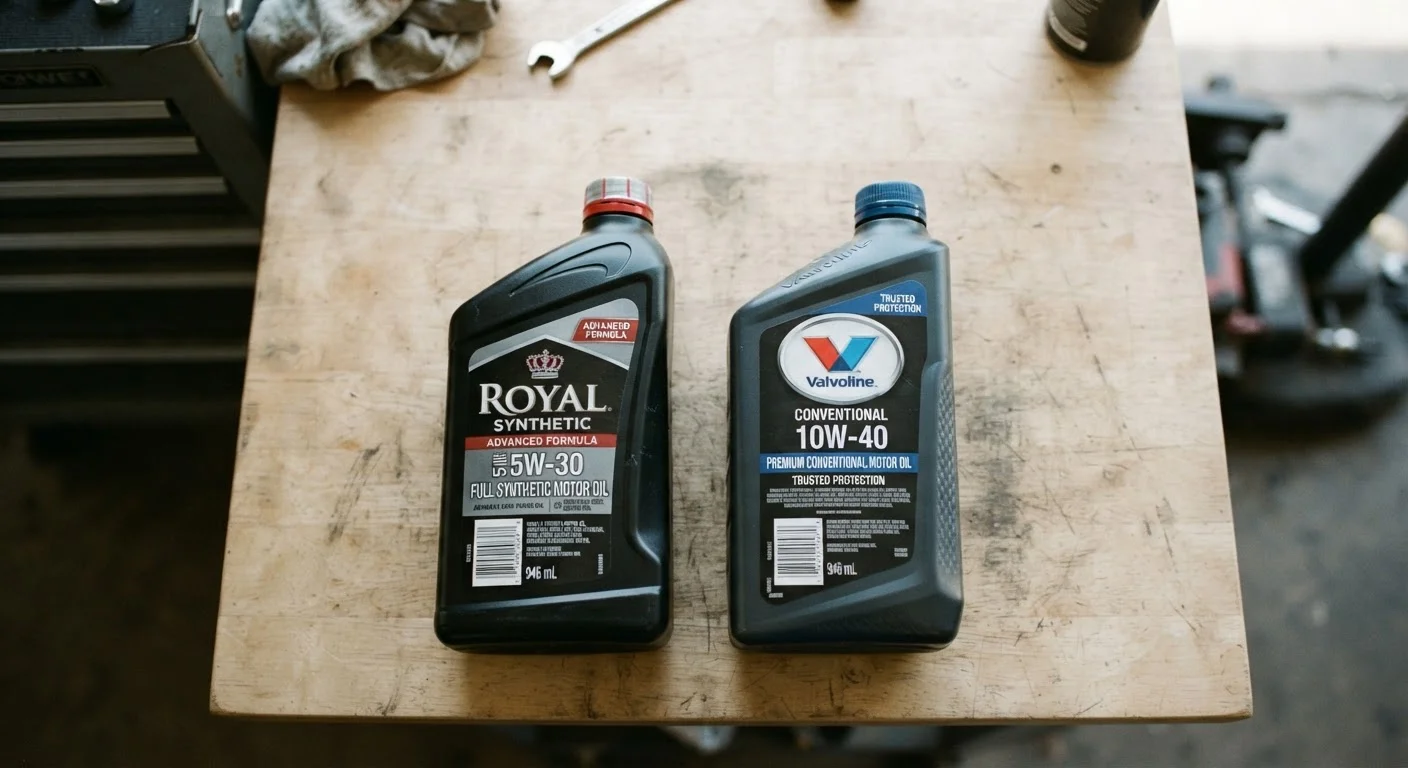
What Makes These Two Oils Different
Motor oil has one core job: reduce friction between moving metal parts inside your engine. Both synthetic and conventional oil accomplish this — but how they're made, and how well they hold up, differs significantly.
Conventional motor oil is refined directly from crude petroleum. During refining, impurities are removed, but some molecular irregularities remain. These inconsistencies can affect how the oil behaves when temperatures rise or fall sharply.
Synthetic motor oil is chemically engineered — either built from scratch using synthesized base stocks or heavily processed from petroleum until the molecular structure is uniform and precise. The result is an oil with more consistent lubrication properties, better resistance to breakdown at high temperatures, and improved flow in cold starts.
For a deeper look at what oil labels like 5W-30 actually mean and why viscosity matters, see our guide to viscosity grades and change intervals.
| Criterion | Synthetic Motor Oil | Conventional Motor Oil |
|---|---|---|
| Base stock origin | Chemically engineered | Refined from crude petroleum |
| Molecular consistency | Uniform, highly refined | Variable, some impurities remain |
| Cold-weather performance | Flows better at low temperatures | Can thicken more in extreme cold |
| High-temperature stability | Resists breakdown at high heat | More prone to thermal degradation |
| Typical change interval | 7,500–10,000+ miles (varies by manufacturer) | 3,000–5,000 miles (varies by manufacturer) |
| Cost per quart | Higher upfront cost | Lower upfront cost |
| Turbo/high-performance engines | Generally required or strongly recommended | Often not sufficient for these engines |
| Older, naturally aspirated engines | Compatible; check manual | May be specified by manufacturer |
When Each Oil Type Is Appropriate
The single most reliable guide to which oil your vehicle needs is the owner's manual. Manufacturers specify oil type and viscosity grade based on engine tolerances, operating temperatures, and design requirements — not marketing.
Use synthetic oil if:
- Your owner's manual specifies full synthetic or synthetic blend.
- Your engine is turbocharged or supercharged — forced-induction engines run hotter and need oils that resist thermal breakdown.
- You regularly drive in very cold winters or very hot summers.
- Your vehicle uses a direct-injection engine, which is more prone to low-speed pre-ignition (a type of abnormal combustion) without the right lubrication.
Conventional oil may be appropriate if:
- Your owner's manual explicitly permits conventional oil.
- Your vehicle is an older model with a naturally aspirated engine and a history of conventional oil use.
- You change oil on a consistent, shorter schedule and operate in moderate conditions.
If you're researching how different drivetrain configurations affect maintenance needs, our article on choosing between transmission types provides useful context alongside engine considerations.
Cost, Intervals, and Practical Considerations
Synthetic oil costs more per quart than conventional oil — sometimes two to four times as much. However, synthetic oil generally supports longer drain intervals. Many manufacturers allow 7,500 to 10,000 miles between changes with full synthetic, compared to 3,000 to 5,000 miles typically associated with conventional oil. Over time, fewer changes can offset some of the price difference.
That said, oil change intervals are not universal. Severe driving conditions — frequent short trips, stop-and-go traffic, towing, or dusty environments — shorten effective oil life regardless of oil type. Always use the severe-service interval in your manual if those conditions apply to you.
One common question is whether switching from conventional to synthetic harms an engine. In properly maintained engines, the switch is generally safe. Synthetic oil does not cause seals to leak — a persistent myth tied to older, poorly maintained engines where existing deposits were dislodged. If your engine already has a high-mileage history on conventional oil and no known leaks, a switch to synthetic is unlikely to cause problems, but consult a qualified mechanic if you have concerns specific to your vehicle.
For more detail on how synthetic and conventional formulations compare at a chemical level, see what actually differs between synthetic and conventional engine oil.
This article provides general educational information about motor oil types. Always follow your vehicle manufacturer's specifications for oil type, viscosity, and change intervals. If you are unsure which oil is appropriate for your engine, consult a qualified mechanic.