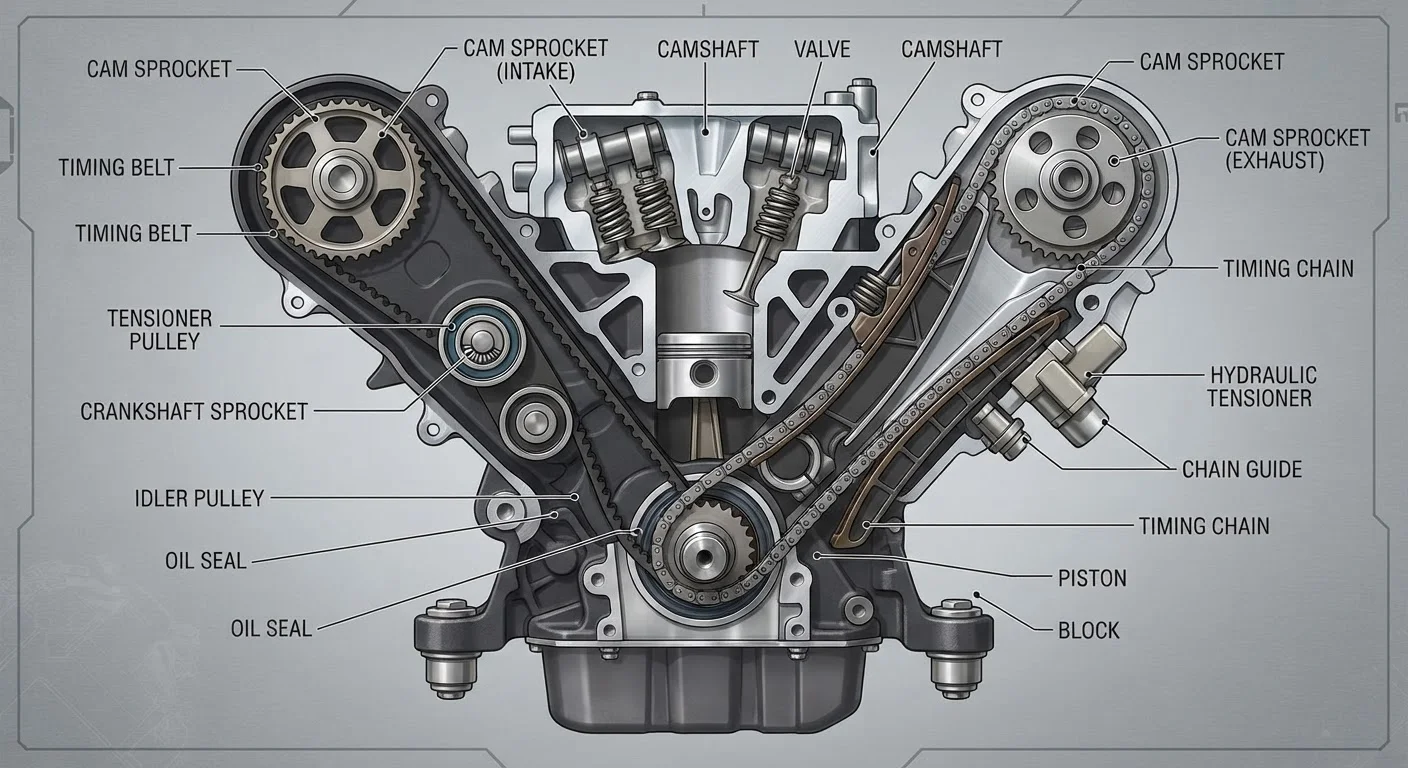
What Each Component Actually Does
Both the timing belt and the timing chain serve the same fundamental purpose: they link the crankshaft (which drives the pistons) to the camshaft (which opens and closes the engine valves). Keeping these two shafts synchronized is critical — even a small timing error can cause the pistons and valves to collide inside the engine, resulting in catastrophic damage.
The difference lies in material and design. A timing belt is made from reinforced rubber, similar in appearance to a ribbed drive belt. A timing chain is a metal roller chain, much like a bicycle chain but engineered to much tighter tolerances. Some engines use a timing gear set instead, though belts and chains are by far the most common arrangements in modern vehicles.
Because your entire car maintenance plan is shaped by which component your engine uses, identifying which one you have is the logical first step.
How to Tell Which One Your Engine Has
The quickest way to find out is to check your owner's manual. Look for the maintenance schedule section — if there is a listed replacement interval for the timing belt (often listed as a mileage and/or year milestone), your engine has a belt. If no such interval appears, you likely have a chain.
A mechanic can also confirm this during any routine inspection. In some cases, you can partially identify the type by listening: a timing chain often produces a faint metallic rattle when the engine is cold, whereas a belt runs silently. However, audio cues alone are not a reliable diagnostic method.
For a broader look at what your vehicle's service schedule actually contains and why each item matters, see your car's maintenance schedule explained.
| Criterion | Timing Belt | Timing Chain |
|---|---|---|
| Material | Reinforced rubber | Metal roller chain |
| Typical lifespan | 60,000–100,000 miles | Engine lifetime (with proper oil changes) |
| Scheduled replacement | Yes — required by manufacturer | No — replaced only if worn |
| Failure warning signs | Often none before sudden failure | Rattle, rough idle, check-engine light |
| Noise level | Very quiet | Slight metallic noise when cold |
| Risk if it fails | High — potential engine damage | Moderate — usually gives warning first |
| Ongoing maintenance cost | Recurring replacement cost | Low unless chain/tensioner wears |
Maintenance Requirements and Failure Risks
Timing belts have a finite lifespan. Most manufacturers specify replacement between 60,000 and 100,000 miles, or after a set number of years — whichever comes first. Rubber degrades over time regardless of mileage, so calendar age matters. If a belt snaps, the consequences in many engines are immediate and severe: bent valves, damaged pistons, or a ruined engine block. These are called interference engines, where the pistons and valves share the same space and rely entirely on correct timing to avoid contact.
Timing chains, by contrast, are designed to last the life of the engine when oil is changed regularly. They do not have a scheduled replacement interval under normal conditions. When chains do wear, they typically provide warning signs — a rattling noise, a check-engine light related to camshaft timing, or rough running — before complete failure occurs. That said, neglecting oil changes accelerates chain and tensioner wear significantly.
Understanding when to handle a job yourself versus consulting a professional is important here. Timing component service is complex and carries real risk if done incorrectly. Our guide on when to use a mechanic vs. DIY can help you assess your situation honestly.
Cost Considerations Over Time
Timing belt replacement is a significant service. Labor is the dominant cost because accessing the belt typically requires removing several other components. Parts — the belt itself, plus the water pump and tensioner pulleys often replaced at the same time — add to the total. Skipping the service to save money in the short term is a common mistake that can result in repair bills many times higher if the belt fails.
Timing chains generally eliminate this recurring cost. However, if a chain, tensioner, or guide does wear out — often due to low oil levels or extended oil change intervals — the repair can be equally or more expensive than belt service, since the labor involved is comparable.
The practical takeaway: neither system is entirely maintenance-free. Both reward attentive owners who follow their vehicle's service schedule and maintain proper oil levels. For a clear walkthrough of what routine upkeep actually looks like, see how to read your vehicle's maintenance timeline.
This article is for general informational purposes only. Always consult your vehicle's owner's manual and a qualified mechanic for guidance specific to your make and model.