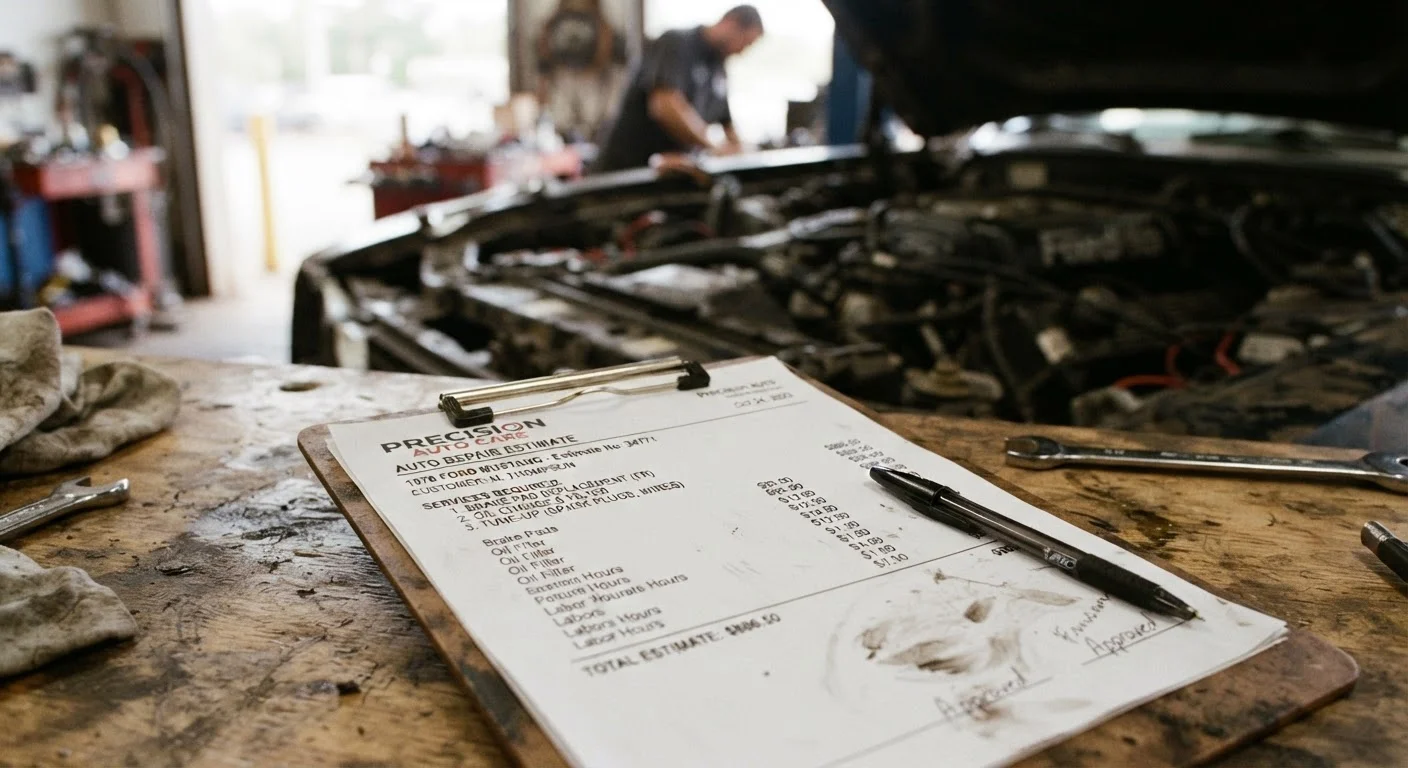
What a Repair Estimate Actually Is
A repair estimate is a formal document that breaks down the projected cost of fixing your vehicle before any work begins. Think of it as a menu: it lists each service, the time a technician expects to spend on it, and the price of any parts required. It is not a final invoice, and — critically — it is not a commitment to proceed unless you sign to authorize the work.
Shops produce estimates in one of two ways. A visual inspection estimate is based on what a technician can see without disassembly. A diagnostic estimate comes after the shop has used scan tools, test drives, or partial teardowns to pinpoint the fault. Diagnostic work usually carries its own fee, which may or may not be credited toward your final bill if you proceed — ask before you agree to the inspection.
Most states have consumer protection regulations requiring shops to provide written estimates above a certain dollar threshold and to obtain your authorization before exceeding that amount. Knowing this protects you: you are not obligated to pay for work you did not approve. For a broader look at routine upkeep context, see A Beginner's Map to Car Maintenance.
Breaking Down the Line Items
Every estimate is organized around a few core cost categories. Understanding each one lets you evaluate the quote intelligently rather than accepting it as a single lump sum.
Labour Rate
The hourly charge a repair shop applies for a technician's time. It varies by shop type and location.
Diagnostic Fee
A charge for the time and tools used to identify what is wrong with your vehicle before any repair work begins.
OEM Parts
Parts made by or to the exact specification of your vehicle's original manufacturer, ensuring a factory-standard fit.
Aftermarket Parts
Replacement parts made by third-party suppliers, often at a lower cost than OEM, with quality that varies by brand.
Remanufactured Parts
Used components that have been professionally rebuilt to a functional standard — commonly alternators, starters, and calipers.
Labour Guide
A standardized industry reference that lists expected repair times for specific jobs on specific vehicles, used to calculate labour charges.
Labour
Labour is typically billed as an hourly rate multiplied by the number of hours flagged for each job. Shops often use a published labour guide — a standardized database that lists how long a specific repair should take on a specific vehicle — rather than tracking actual clock time. This means a faster-than-average technician still bills the guide time. Labour rates at franchised dealerships tend to run higher than at independent shops, reflecting facility costs and specialized training.
Parts
Parts costs appear as a line item per component. Shops typically purchase parts at a wholesale price and charge you a marked-up retail price — that markup is standard practice and is how shops cover procurement, storage, and warranty handling. The estimate should list the part name and, ideally, the part number so you can verify what is being installed.
Shop Supplies and Fees
Many estimates include a miscellaneous charge labeled shop supplies or environmental fees. These cover small consumables like rags, solvents, and fluid disposal. They are generally legitimate but worth noting — on a large job they can add meaningfully to the total.
Parts: OEM, Aftermarket, and Remanufactured
Not all replacement parts are created equal, and the type specified on your estimate affects both cost and long-term reliability.
- OEM (Original Equipment Manufacturer): Made by or to the exact specification of your vehicle's manufacturer. These typically cost more but offer a predictable fit and often come with a manufacturer warranty.
- Aftermarket: Produced by independent suppliers. Quality ranges widely — some aftermarket parts meet or exceed OEM standards; others do not. Ask the shop which brand they use and what warranty the part carries.
- Remanufactured (Reman): Used cores that have been rebuilt to a serviceable standard. Common for alternators, starters, and brake calipers. A reputable reman part from a known supplier can be a sound, cost-effective choice.
Ask for the Part Number
When a shop lists a part on your estimate, request the specific part number. This lets you verify the part type (OEM vs. aftermarket) and look up its warranty independently. A shop that hesitates to provide part numbers is worth approaching with extra caution.
For guidance on deciding when to handle something yourself versus handing it to a professional, Mechanic or DIY walks through the factors to weigh.
Questions to Ask Before You Sign
Authorizing a repair is a financial decision, and it pays to ask a few direct questions before you commit. None of these are unreasonable — reputable shops expect them.
- Is this estimate written and itemized? A verbal quote offers no protection. Request a printed or emailed document before work begins.
- Does the diagnostic fee apply toward the repair? Some shops credit it; others do not. Know this upfront.
- What type of parts are being used, and what warranty do they carry? Ask specifically about labour warranty too — will the shop stand behind the repair if the same issue recurs?
- What happens if additional problems are found mid-repair? A trustworthy shop will contact you for authorization rather than proceeding and billing you after the fact.
- Can any work be safely deferred? Not every flagged item is urgent. Ask the mechanic which repairs are safety-critical versus which can wait for your next visit.
For a structured walkthrough of the authorization process, see Before You Authorise Any Repair. And if you want to make the most of the visit itself, Getting the Most Out of a Mechanic Visit covers what to bring and what to ask when you arrive.
This article is for general informational purposes only. Repair costs, regulations, and shop practices vary by location and vehicle. Consult a qualified mechanic for advice specific to your vehicle's condition.