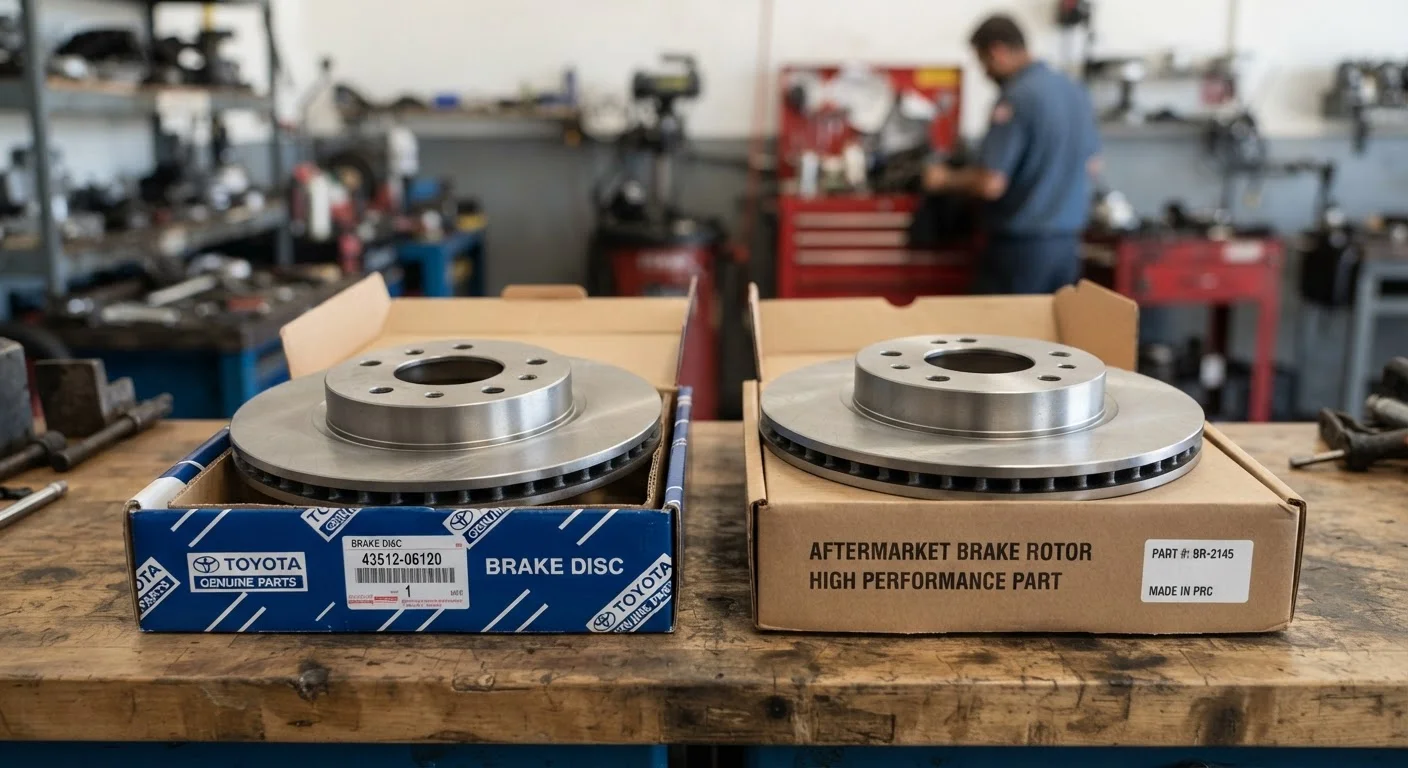
What OEM and Aftermarket Actually Mean
OEM stands for Original Equipment Manufacturer. An OEM part is made by — or to the exact specifications of — the company that built your vehicle. In practice, this often means the part was produced by a supplier that also supplied the assembly line when your car was built, then repackaged under the automaker's brand. What you're guaranteed is that the part matches your vehicle's design precisely.
Aftermarket parts are made by third-party manufacturers that are not affiliated with your vehicle's maker. They're designed to fit and function like the original part but are produced independently. The aftermarket parts industry is large and diverse — it includes everything from budget-tier components with minimal testing to premium-grade parts engineered to strict tolerances.
It's worth noting that neither label alone tells you the full story. An OEM part isn't automatically superior in every situation, and an aftermarket part isn't automatically inferior. Context matters. For a deeper look at related terminology — including rebuilt and remanufactured parts — see our guide to remanufactured, rebuilt, and used parts.
How They Compare Across Key Factors
The clearest way to evaluate OEM versus aftermarket parts is to look at specific dimensions: fit, quality, cost, availability, and warranty impact.
| Criterion | OEM Parts | Aftermarket Parts |
|---|---|---|
| Fit & compatibility | Guaranteed match to vehicle specs | Varies by manufacturer; usually compatible |
| Quality consistency | Consistent; built to original standard | Wide range — from budget to premium tiers |
| Typical cost | Higher; often 20–60% more than aftermarket | Generally lower, but varies significantly |
| Availability | Limited to dealerships and authorized suppliers | Broadly available through many channels |
| Warranty impact | No risk to factory warranty | Protected under Magnuson-Moss Act if installed correctly |
| Best suited for | New vehicles, safety-critical repairs | Older vehicles, routine wear items, budget repairs |
Fit is where OEM has a clear edge. Because the part is built to the vehicle's exact specifications, installation is straightforward and compatibility is not a concern. With aftermarket parts, fit can vary. Reputable manufacturers test their parts against OEM specs, but discrepancies — in mounting points, sensor connectors, or dimensions — do occasionally occur, particularly with lower-tier products.
On cost, aftermarket typically wins, though not universally. High-performance or precision aftermarket parts can actually exceed OEM prices. The pricing spread in the aftermarket is wide, and cost alone is not a reliable quality indicator.
Will Aftermarket Parts Affect Your Warranty?
This is one of the most common concerns owners have, and it's worth addressing directly. Under the Magnuson-Moss Warranty Act, a federal law, a vehicle manufacturer generally cannot void your warranty simply because you used an aftermarket part — unless they can demonstrate that the aftermarket part caused the specific failure in question.
That said, some nuance applies. If an aftermarket part is incorrectly installed or is clearly substandard, and that part directly causes a failure, the manufacturer may have grounds to deny a warranty claim for that related repair. The warranty on other, unrelated systems would remain intact.
The Magnuson-Moss Warranty Act — What It Covers
Enacted in 1975, this federal law protects consumers by preventing manufacturers from voiding warranties solely because an aftermarket part was used. The manufacturer must prove the aftermarket part caused the specific defect. This protection applies to parts and service, though it does not cover modifications that are clearly outside normal use. When in doubt, document your repairs and keep receipts for any parts you purchase.
If your vehicle is still under a factory warranty and you have concerns, consult your warranty documentation or a qualified mechanic before making a parts decision. For a broader look at how warranty language works, see our guide to reading warranty coverage.
Making the Right Call for Your Situation
There is no single correct answer for every driver or every repair. The decision depends on several practical factors:
- Vehicle age and value: On a newer or high-value vehicle, OEM parts preserve the investment. On an older car, the economics often favor quality aftermarket alternatives.
- Part type: Safety-critical systems — brakes, steering, airbag components — warrant the highest confidence in fit and function. Routine consumables like air filters or cabin filters are lower-stakes decisions.
- Aftermarket brand reputation: Not all aftermarket manufacturers are equal. Look for parts that carry recognized quality certifications, and ask your mechanic which brands they trust for specific components.
- Where you source parts: Where a part comes from affects cost, quality assurance, and warranty coverage. Our overview of parts sourcing routes covers dealerships, independent shops, and self-supply in detail.
A qualified mechanic can also help you weigh the tradeoff for a specific repair on your specific vehicle — that guidance is often the most reliable input you can get.
This article is for general informational purposes only and does not constitute professional mechanical or legal advice. Consult a licensed mechanic or appropriate professional for decisions specific to your vehicle and circumstances.