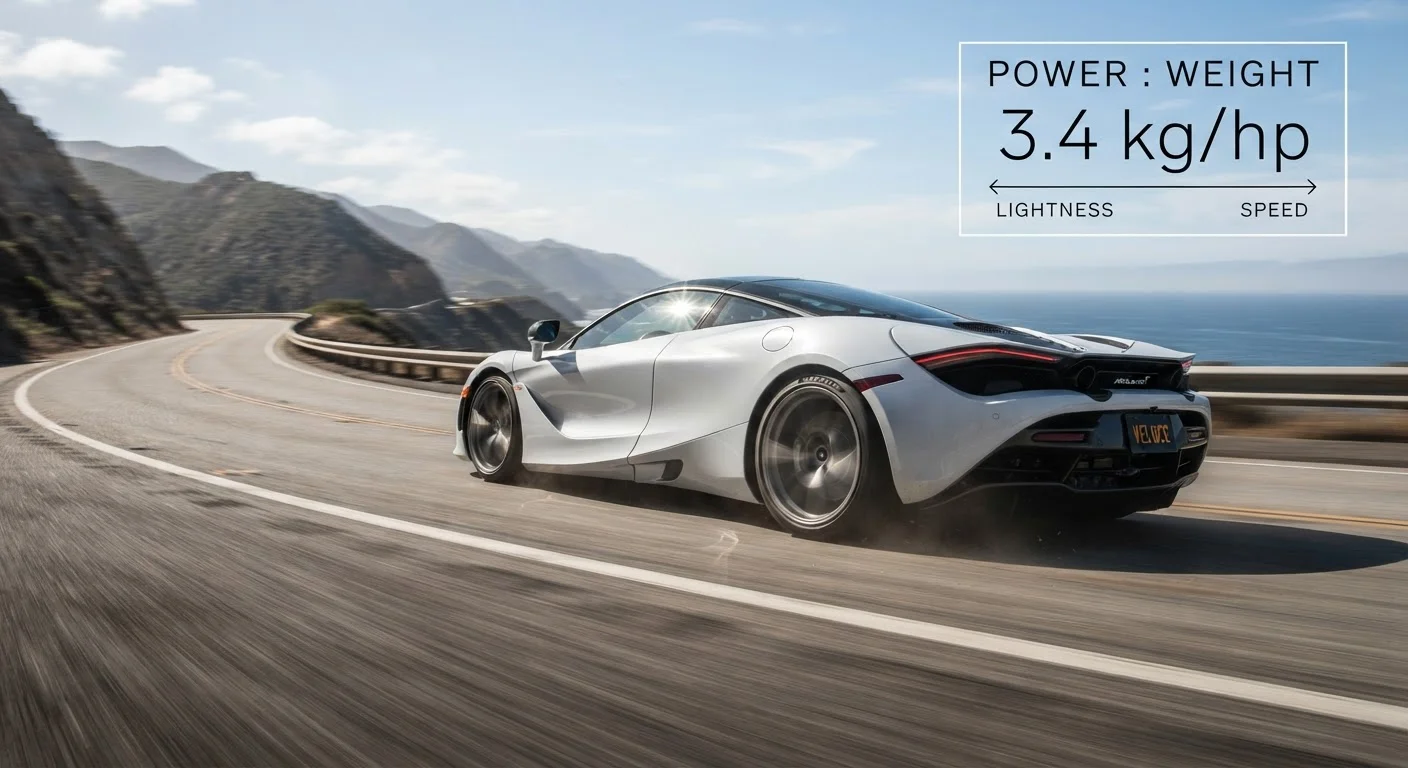
Why Horsepower Alone Doesn't Tell the Full Story
When shoppers compare two vehicles, horsepower is usually the number that gets the most attention. It's printed on the window sticker, highlighted in advertisements, and repeated in reviews. But horsepower by itself answers only half the question. The other half is: how much does the car weigh?
Imagine two sedans. One produces 250 hp and weighs 4,200 lbs. The other makes 220 hp and weighs 3,100 lbs. Most buyers would assume the first car is quicker — it has more power, after all. In practice, the lighter car has a significantly better power-to-weight ratio and will almost certainly feel more responsive in everyday driving. That's the gap power-to-weight ratio fills.
For a deeper look at how horsepower interacts with other performance figures, see our guide to horsepower vs. torque.
How to Calculate It — and What the Numbers Mean
The calculation is straightforward. Take the vehicle's advertised horsepower and divide it by the curb weight in pounds. The result, expressed as pounds per horsepower (lb/hp), tells you how much mass each unit of power must move.
- Below 10 lb/hp: High-performance territory. Acceleration is sharp and the car responds instantly to throttle input.
- 10–15 lb/hp: Sporty to engaging. Merging, passing, and uphill driving feel effortless.
- 15–20 lb/hp: Typical for mainstream sedans, crossovers, and family vehicles. Adequate performance for most driving situations.
- Above 20 lb/hp: Common in larger trucks, vans, and heavily loaded vehicles. Performance is functional rather than spirited.
These benchmarks are general guides, not hard rules. Transmission type, torque delivery, and aerodynamics all shape how a given ratio feels in practice. You can find curb weight figures on the manufacturer's website, in the owner's manual, or on the vehicle's door jamb sticker.
~3,900 lbs
Average curb weight of a new midsize sedan
EPA and manufacturer data consistently show that average passenger vehicle weight has increased significantly over the past two decades due to safety equipment, larger cabins, and technology additions.
15–20 lb/hp
Typical power-to-weight range for mainstream family vehicles
This range covers most non-performance sedans, crossovers, and standard SUVs sold in the US market and reflects adequate but not spirited everyday performance.
~8 lb/hp
Power-to-weight ratio of a dedicated sports car
High-performance two-seat sports cars routinely achieve ratios below 8 lb/hp by combining powerful engines with lightweight construction techniques.
Weight's Broader Effect on Ownership
Power-to-weight ratio isn't only about zero-to-sixty times. Weight affects the entire ownership experience in ways that don't show up in a brochure.
Braking: Heavier vehicles carry more momentum and generally need more distance to stop. Brake components also wear faster under repeated heavy stops.
Handling: Mass creates inertia. A lighter car changes direction more crisply and places less lateral load on tires through corners, which also extends tire life.
Fuel consumption: Every extra pound the engine moves consumes additional energy. Weight is one of the most consistent contributors to real-world fuel use — something official ratings don't always capture clearly. Our article on fuel economy figures and what they leave out explains why official consumption numbers can be misleading.
For a closer look at how weight and power interact at the point of purchase, see what curb weight and power-to-weight ratio tell you about a car's feel.
Using This Spec When Comparing Vehicles
When you're evaluating vehicles in a similar price range or segment, calculating the power-to-weight ratio for each option adds a layer of comparison that raw specifications miss. It's particularly useful when:
- Comparing a crossover to a sedan — crossovers are typically heavier, which can offset the larger engine they often carry.
- Evaluating trim levels — a higher trim with a more powerful engine might also add weight through features, partially negating the gain.
- Considering a used vehicle — older listings rarely include performance context, but curb weight and horsepower are almost always documented.
Power-to-weight ratio is one of several metrics worth understanding before committing to a purchase. Our guide to performance specs buyers should prioritise puts it in context alongside other figures on a spec sheet. And if you want a full walkthrough of how to read spec sheets from start to finish, our performance spec sheet decoder covers every key metric in plain language.
A single afternoon of research — calculating this ratio for your shortlisted vehicles — can meaningfully change which option feels like the right fit.