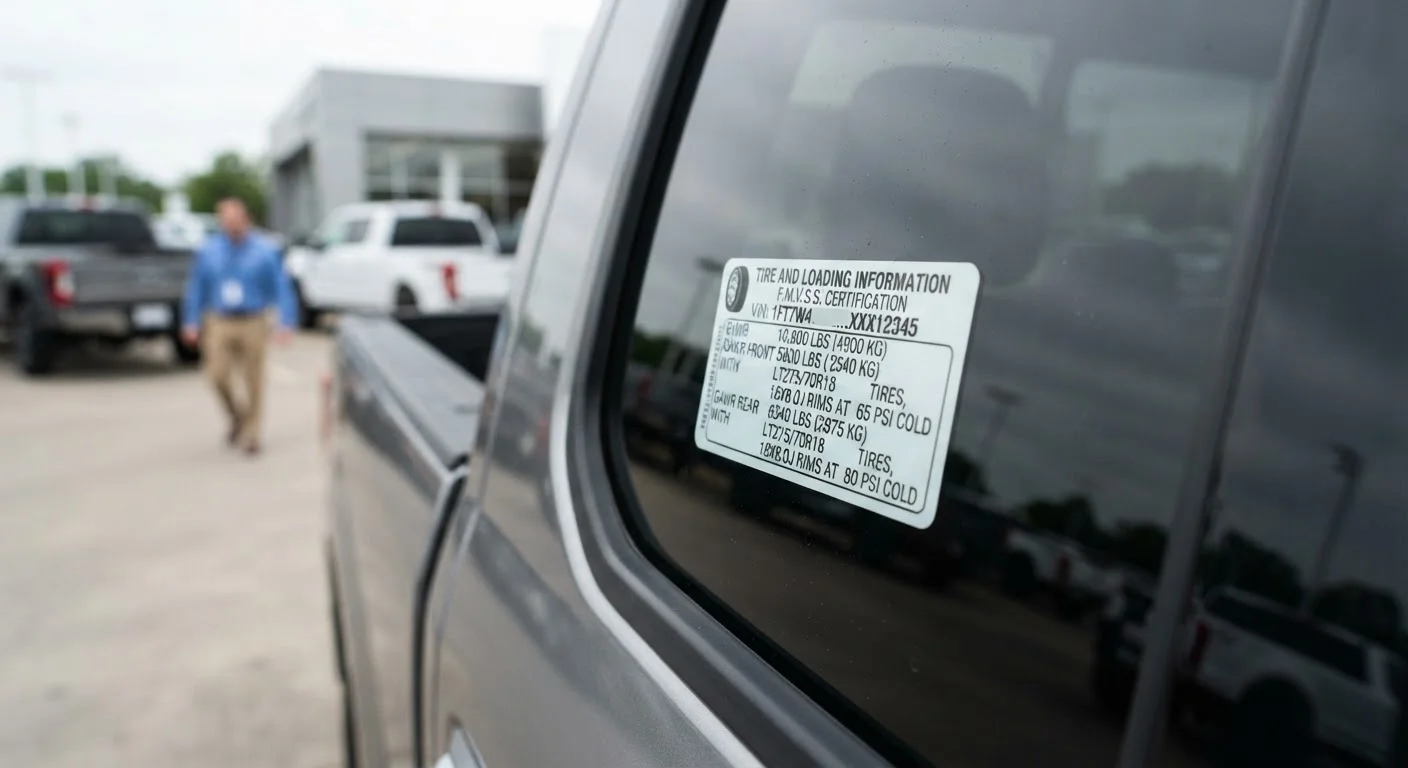
What Every Number on That Sticker Actually Measures
A truck's window sticker - formally called the Monroney label - is a federally mandated document that discloses far more than MSRP. Buried beneath the price and option codes are weight ratings that determine whether a truck can legally and safely handle your intended workload. Misreading them is one of the most common and costly mistakes truck buyers make.
The four ratings that matter most are GVWR, GCWR, payload capacity, and maximum tow rating. Each measures something distinct, and none is interchangeable with another. As a companion to this guide, our breakdown of payload vs. towing capacity explains why buyers routinely conflate the two and how to avoid that mistake.
GVWR: The Truck's All-In Weight Limit
Gross Vehicle Weight Rating (GVWR) is the maximum allowable weight of the fully loaded truck - that means the vehicle itself plus every passenger, every pound of cargo in the bed or cabin, and a full tank of fuel. It is set by the manufacturer based on structural engineering and braking capability, not marketing.
To find actual payload capacity, subtract the truck's curb weight (the weight of the vehicle empty with fluids) from the GVWR. The result is the maximum combined weight of cargo and passengers. A sticker may list payload capacity directly, but it is worth cross-checking against GVWR because trim and option packages add weight that reduces your effective payload headroom.
GVWR
Gross Vehicle Weight Rating - the maximum allowable total weight of a truck when fully loaded, including vehicle structure, all occupants, cargo, and fluids. Set by the manufacturer based on structural and braking limits.
GCWR
Gross Combined Weight Rating - the maximum total weight the powertrain is rated to move, covering both the loaded truck and the loaded trailer simultaneously.
Curb Weight
The weight of the truck as delivered with all standard fluids (fuel, oil, coolant) but without passengers or cargo. The baseline subtracted from GVWR to find payload capacity.
GAWR
Gross Axle Weight Rating - the maximum load a single axle assembly is designed to carry. Front and rear axles carry separate ratings that must each be respected independently.
Tongue Weight
The static downward force a trailer's coupler exerts on a hitch ball. Proper tongue weight - usually 10-15% of total trailer weight - is critical for preventing trailer sway.
Monroney Label
The federally required window sticker affixed to new vehicles disclosing MSRP, fuel economy, standard features, and manufacturer-set weight ratings. Named after the U.S. senator who sponsored the enabling legislation.
Exceeding GVWR strains brakes, suspension, and tires beyond their rated limits - a genuine safety issue, not a technicality. It can also void warranty coverage and create liability exposure in the event of an accident. For a broader look at how weight figures interact with driving dynamics, see how curb weight and power-to-weight ratio shape real-world feel.
GCWR: The Combined System Weight When Towing
Gross Combined Weight Rating (GCWR) covers the total weight the truck's powertrain is rated to move: the loaded truck itself plus the loaded trailer. This is the ceiling your tow setup must stay under, not just the trailer alone.
Here is where buyers frequently overestimate capability. Advertised tow ratings assume a specific configuration - often a base cab with minimum options, no passengers, and a lightly loaded bed. Add a crew cab, a sunroof, heavier wheels, and two adult passengers, and your curb weight climbs, which reduces how much trailer weight the GCWR allows. The math is straightforward: Maximum trailer weight = GCWR − actual loaded truck weight.
Always use your truck's actual weight - not curb weight from a spec sheet - as the starting point. If you can, weigh the loaded truck at a certified scale before selecting a trailer. Staying within GCWR protects the transmission, cooling system, and chassis from cumulative stress that typically shows up as expensive repairs long after the warranty expires.
Other Ratings Worth Noting
Beyond GVWR and GCWR, a truck's sticker or door jamb placard may reference several additional ratings:
- GAWR (Gross Axle Weight Rating): The maximum load each individual axle can support. Front and rear axles carry different ratings. Overloading a single axle - even if total GVWR is not exceeded - can cause structural damage and handling problems.
- Tongue weight rating: The downward force a hitch ball can accept from a trailer's coupler. Typically 10-15% of the trailer's total weight; exceeding it causes trailer sway and rear axle overload.
- Fifth-wheel and gooseneck ratings: Separate, higher ratings listed for trucks equipped with in-bed hitch systems. These differ substantially from conventional hitch ratings and apply only with the correct receiver hardware installed.
Spec sheets across different truck lines use these figures consistently, but the way they're tested and presented can vary. Our guide to reading performance spec sheets provides context on how manufacturer testing methods affect the numbers you see. For a full glossary of terms you'll encounter across vehicle comparisons, the spec sheet glossary is a useful plain-language reference.