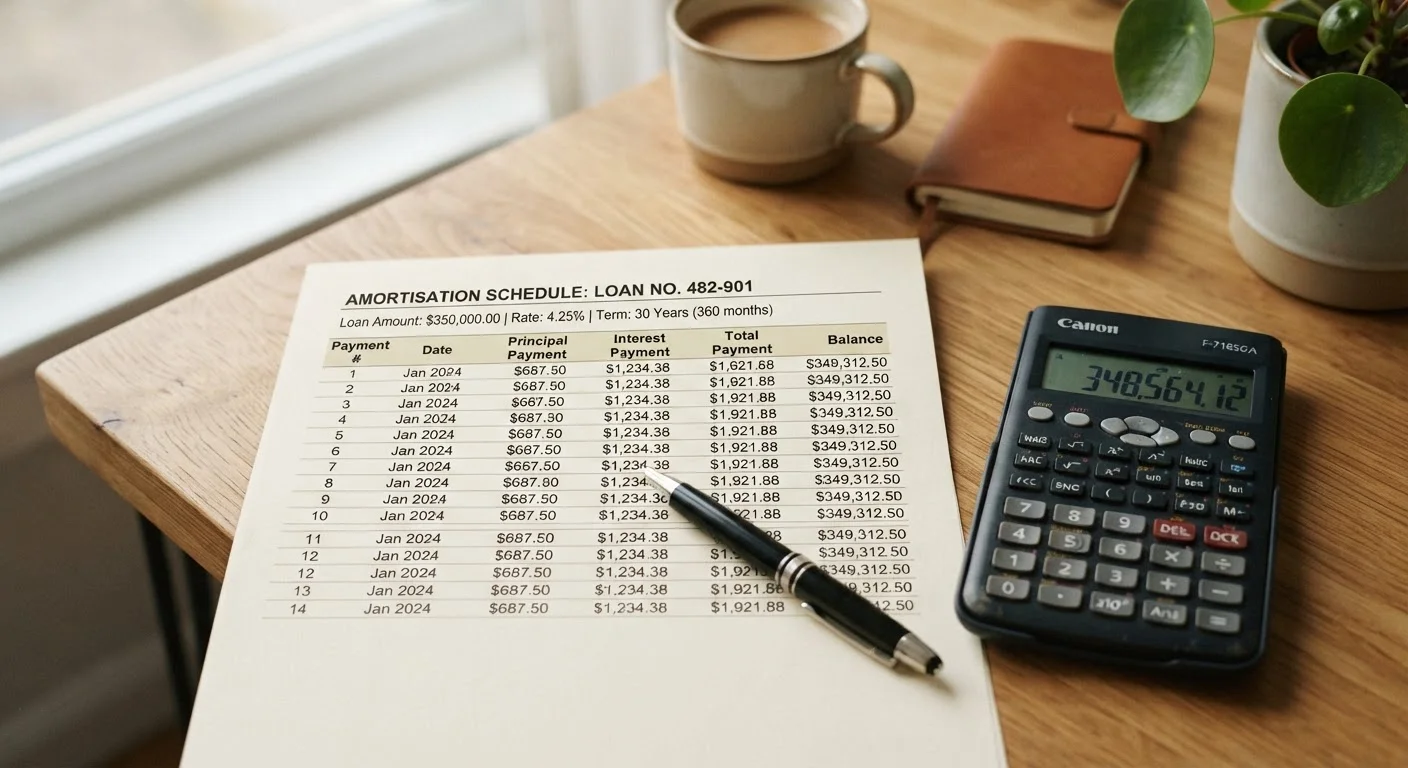
What an Amortisation Schedule Actually Shows
An amortisation schedule is a complete, payment-by-payment table showing how every dollar of your auto loan is allocated over the life of the loan. Each row represents one payment period - typically one month - and breaks that payment into three pieces: the portion applied to interest, the portion applied to principal (the original amount borrowed), and the remaining balance still owed after that payment.
Understanding this structure is foundational. If you're new to how auto loans work mechanically, the auto loans explained guide covers the underlying concepts - principal, APR, and loan terms - in plain language before you dive into reading a schedule line by line.
The key insight baked into every amortisation schedule: your fixed monthly payment stays the same throughout the loan, but what that payment accomplishes changes dramatically from month to month. In the early months, a large share goes to interest. As the balance falls, the interest charge shrinks, and a growing share chips away at principal. This pattern is called front-loaded interest, and it has real implications for when extra payments make sense.
What You'll Need Before You Start
You don't need the physical schedule from your lender - you can generate one yourself using free online loan calculators. Gather the following before proceeding:
What you will need
For definitions of any terms you encounter - such as APR, loan term, or outstanding balance - the auto loan glossary is a useful companion reference.
How to Read the Schedule Step by Step
Follow these steps to extract the information that actually matters for your borrowing decisions.
Locate or Generate Your Schedule
Ask your lender for a printed or digital amortisation schedule - most are required to provide one on request. Alternatively, enter your loan's principal, APR, and term into a free online loan amortisation calculator to generate an identical table yourself. Confirm the monthly payment figure matches your actual loan agreement before proceeding.
Identify the Four Core Columns
Every amortisation schedule contains at least four columns: Payment Number (the month), Payment Amount (your fixed monthly total), Interest Charged (the cost of borrowing for that period), and Principal Applied (the balance reduction). A fifth column, Remaining Balance, shows what you still owe after each payment. Confirm you can locate all five before reading further.
Read the First Row Carefully
Row one represents your first payment. The interest charged equals your outstanding balance multiplied by your monthly interest rate (APR ÷ 12). The principal applied is whatever remains after subtracting that interest from your total payment. Notice how little of your first payment reduces the actual balance owed - this is normal for front-loaded amortisation and not a lender error.
Scan Down the Interest and Principal Columns
Scroll or scan down the schedule and watch two trends: the Interest Charged column gradually decreases with each row, and the Principal Applied column gradually increases by a corresponding amount. The payment total stays fixed - what shifts is the split. This visual pattern is the core mechanic of amortisation and shows why early payoff saves the most money.
Find the Total Interest Row
Scroll to the final row or look for a summary line at the bottom of the schedule labeled Total Interest Paid or Finance Charge. This single figure tells you the full cost of borrowing - the amount you pay above and beyond the original principal. Comparing this number across different loan offers (varying rates or terms) is one of the clearest ways to evaluate which financing arrangement costs less overall.
Using the Schedule to Make Smarter Payment Decisions
Once you can read the schedule fluently, you can use it strategically. The most actionable insight is identifying the inflection point - the payment number where the principal portion first exceeds the interest portion. Payments made before that point deliver the greatest interest savings per extra dollar applied, because the outstanding balance is still high and compounding against you.
Apply Extra Payments to Principal Directly
When making an additional payment, specify in writing or through your lender's online portal that the extra amount should be applied to principal only - not to the next scheduled payment. Applying it to principal reduces your outstanding balance immediately, which lowers the interest calculated for every subsequent month.
Making extra payments also shortens your loan term, which affects your monthly budget planning. The guide to structuring a car payment can help you calculate whether your budget has room for occasional additional principal payments without creating cash-flow strain.
Amortisation is also one of the clearest reasons why a longer loan term costs more overall even when the monthly payment feels affordable. A 72-month loan at the same rate as a 48-month loan generates significantly more total interest - the schedule makes this concrete and quantifiable before you commit. This is a core consideration in the broader auto financing roadmap every first-time borrower should work through.
This article provides general financial education about loan mechanics and is not personalised financial advice. Consult a qualified financial professional for guidance specific to your situation.