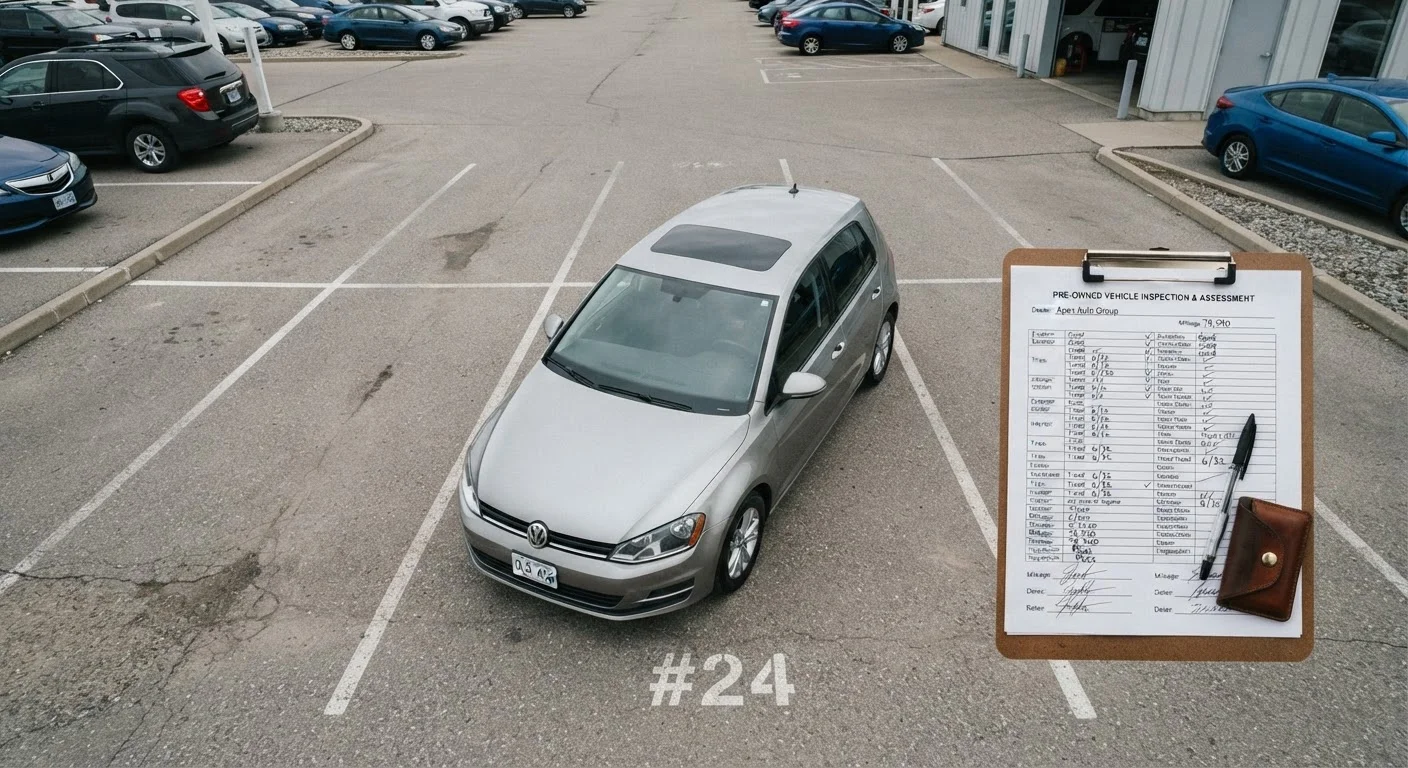
Why Trade-In Offers Vary So Much
If you've ever received two different trade-in quotes for the same vehicle, you're not imagining the gap. Dealer offers aren't arbitrary, but they are influenced by a mix of objective data and local business factors. Understanding what drives those numbers gives you a clearer picture of what to expect — and where there may be room to push back.
Before you step into a dealership, it's worth reviewing the independent valuation tools available to you, so you have a reference range before any offer is made. For unfamiliar terms like trade-in value, book value, or reconditioning, the used car terminology glossary is a useful starting point.
Odometer Reading
Mileage is one of the first data points a dealer uses to anchor a valuation. Lower mileage generally signals less mechanical wear and broader resale appeal, which supports a higher offer. The relationship isn't perfectly linear — a well-maintained higher-mileage vehicle can outperform a neglected low-mileage one — but mileage remains a primary filter in both dealer and third-party valuation tools.
Most valuation models segment vehicles into mileage bands. Crossing a round-number threshold (such as 100,000 miles) can produce a noticeable drop in estimated value, even if the mechanical difference is minimal.
Crossing a high-mileage threshold can noticeably reduce your trade-in offer, even with minimal mechanical difference.
Physical Condition
Dealers use a condition grading system — typically ranging from rough to excellent — to estimate how much they'll need to spend before reselling the vehicle. Dents, scratches, worn upholstery, cracked trim, and windshield chips all represent reconditioning costs, which are subtracted from what they're willing to offer you.
Even cosmetic flaws that seem minor to an owner can represent several hundred dollars in reconditioning at dealer labor rates. Addressing low-cost repairs before a trade-in appraisal can be worth considering, though not every repair investment translates to an equivalent increase in offer value.
Every cosmetic flaw translates into an estimated reconditioning cost — subtracted directly from your trade-in offer.
Title and Ownership History
A clean title — meaning the vehicle has never been declared a total loss, flooded, or otherwise significantly damaged — is a baseline expectation for full trade-in value. Salvage, rebuilt, or branded titles carry significantly reduced valuations because they limit the pool of potential buyers and may complicate resale or financing for the next owner.
Accident history reported through vehicle history services also factors in, even if the car was properly repaired. Multiple prior owners can similarly reduce perceived value, as it raises questions about the vehicle's history between sales.
A salvage or branded title can sharply reduce trade-in offers due to limited resale options for the dealer.
Local Market Demand
Dealers acquire trade-ins to resell locally. If your vehicle is a body style, trim level, or drivetrain configuration that moves quickly in your region — say, four-wheel-drive trucks in a mountainous area, or fuel-efficient sedans in a dense metro — dealers may offer more because they expect to turn the vehicle quickly. Conversely, if your vehicle has low regional demand, dealers may need to wholesale it, which compresses the offer.
This is why trade-in offers can vary between dealerships, and even between franchised and independent dealers. The new vs. used car tradeoffs discussion is relevant here — dealers managing a new car franchise may value certain trade-ins more if they complement their existing used inventory.
Regional demand for your vehicle's body style and drivetrain directly shapes what dealers are willing to pay.
Service Records and Maintenance History
Documented maintenance — oil changes, brake service, tire rotations — provides evidence that the vehicle was cared for according to manufacturer recommendations. While the absence of records doesn't automatically disqualify a vehicle, having them can support a stronger offer or at minimum reduce the likelihood of a dealer discounting for assumed neglect.
Dealerships that service the brand they sell can sometimes verify maintenance history through their own records, which adds credibility even when the owner doesn't have physical receipts.
Documented maintenance history provides evidence of care and can support a stronger dealer offer.
Outstanding Loan Balance
If you still owe money on the vehicle, the trade-in process becomes a two-part calculation: what the car is worth versus what you owe on it. If the trade-in value exceeds your payoff amount, the difference (positive equity) can be applied toward your next purchase. If you owe more than the vehicle is worth (negative equity, sometimes called being underwater or upside-down), the shortfall is typically rolled into the new loan — increasing what you're financing.
Understanding your payoff amount from your lender before walking into a dealership is essential. Negotiation and paperwork guidance can help clarify how this interacts with the overall deal structure.
Outstanding loan balances directly affect your net trade-in position — know your payoff figure before negotiating.
Keeping the Numbers Clear
One common mistake buyers make is allowing the trade-in and the purchase to get bundled into a single monthly payment discussion. When that happens, it becomes difficult to evaluate whether either number is fair. Negotiating the trade-in separately from the purchase price is one of the clearest ways to protect your overall position.
It's also worth knowing that trade-in value is only one piece of the deal. When comparing used car deals side by side, buyers often focus on sticker price while underweighting what they're actually netting on the vehicle they're giving up. Both sides of the transaction matter equally to the total cost of the deal.
Get at Least Two Independent Valuations
Before visiting a dealership, use at least two independent valuation sources to establish a realistic range for your vehicle. Enter the same mileage, condition rating, and trim level in each tool so the comparisons are consistent. Having this data in hand gives you a clear benchmark when evaluating any dealer offer — and removes the guesswork from the conversation.
This article provides general educational information about trade-in valuations and is not a substitute for personalized advice from a qualified financial or automotive professional. Individual results vary based on specific vehicle condition, market conditions, and dealership policies.