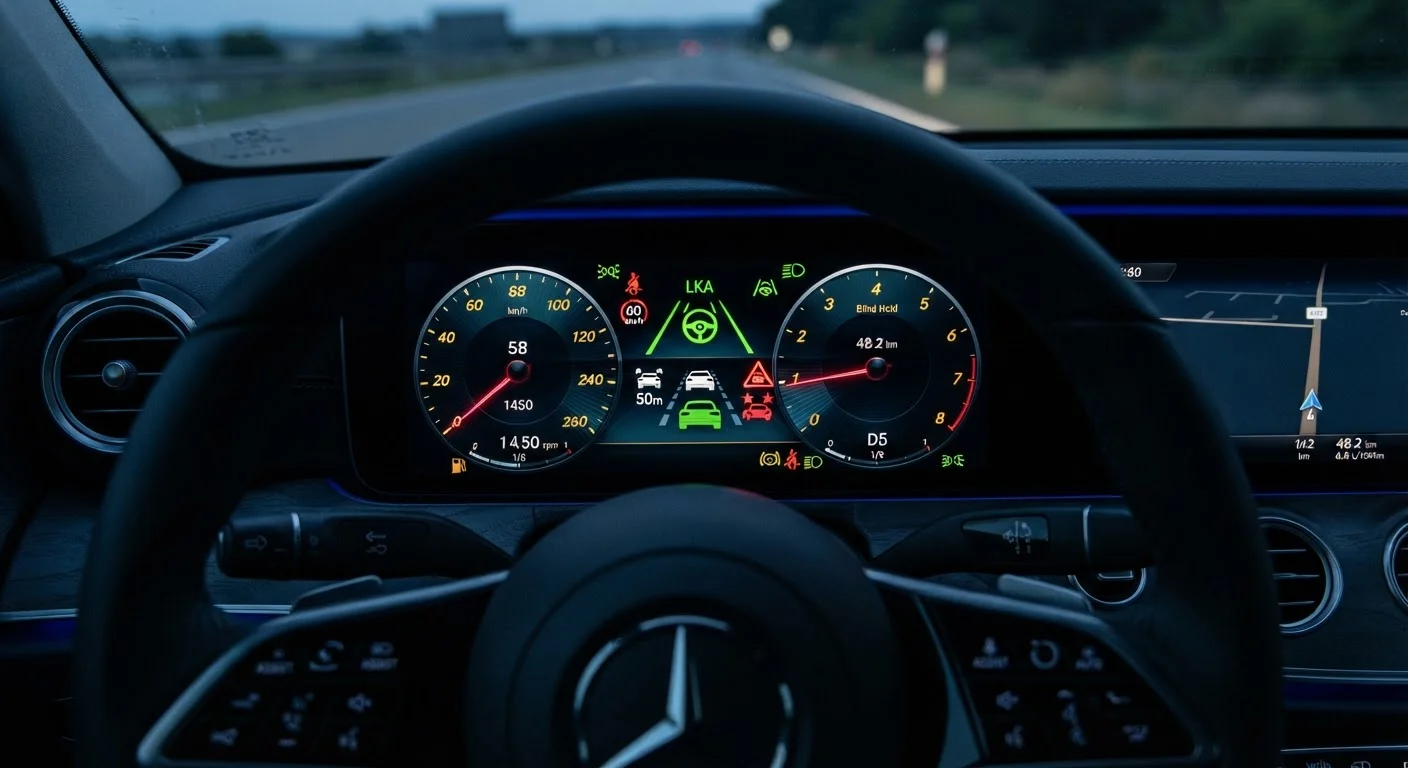
Safety features are frequently split across trim levels — standard on one, optional or unavailable on another.
Automakers use varying names for the same underlying technology, which makes cross-model comparison harder than it looks.
Some safety systems require specific hardware (cameras, radar) that cannot be added after purchase.
Verifying feature availability on a window sticker or build sheet is more reliable than relying on a salesperson's word.
A higher trim price may be justified if it includes safety tech that significantly reduces crash risk.
Safety tech is often split across trim levels. Use this checklist to confirm which features are standard and which require an upgrade.
Why Safety Packages Deserve More Scrutiny Than They Usually Get
When automakers list safety features in their marketing materials, the fine print often matters more than the headline. A feature described as "available" may cost an extra $1,500 as part of an optional package — or it may only appear on the top trim, several steps above the one you're considering. Understanding exactly what's included, on which trim, at what price, is one of the most consequential steps in comparing vehicles.
This checklist is designed to help you cut through that ambiguity. Before you use it, it's worth having a working understanding of what these systems actually do. Our plain-language guide to modern car safety tech explains the underlying mechanics of each system so you can evaluate them on their merits, not just their names.
Work through these items for each trim level you're considering. Bring printed or digital spec sheets if you're at a dealership — having the documentation in front of you keeps the conversation grounded in facts.
Collision Prevention Systems
Confirm automatic emergency braking (AEB) is standard — not optional — on the trim you're evaluating. AEB applies the brakes automatically when a forward collision is imminent and is one of the most well-documented crash-reduction technologies available.Must
Check whether AEB works at highway speeds or only in low-speed city conditions — some systems are limited to under 30 mph.Must
Verify that pedestrian and cyclist detection is included within the AEB system, not sold as a separate add-on.Should
Note whether forward collision warning (FCW) provides an audible and visual alert before AEB activates, giving the driver a chance to brake manually first.Should
Lane and Road Position Assistance
Check whether lane departure warning (LDW) is included, and clarify whether it only alerts or also actively steers — these are different systems with different levels of intervention.Must
Determine if lane centering assist (sometimes called lane-keep assist or lane tracing) is available and whether it requires active hands on the wheel or operates more autonomously.Should
Confirm whether road departure mitigation — which steers and brakes if the car drifts off the road edge — is included or only available on higher trims.Should
Blind-Spot and Rear Detection
Verify that blind-spot monitoring (BSM) is included as standard equipment, not part of an optional package. BSM alerts you when a vehicle is alongside you in your blind zone.Must
Check for rear cross-traffic alert, which warns you of approaching vehicles when reversing out of a parking space.Should
Confirm that a rearview camera is standard — it has been federally required on new vehicles in the US since 2018, but the resolution and display quality vary significantly by trim.Must
Assess whether a surround-view or 360-degree camera system is offered and on which trim it appears.Nice to have
Adaptive and Cruise Technology
Confirm whether adaptive cruise control (ACC) is included — this system automatically adjusts vehicle speed to maintain a safe following distance from the car ahead.Should
Clarify if ACC operates at all speeds including stop-and-go traffic (full-range), or only above a minimum speed threshold.Should
Note whether the system requires a specific hardware configuration (radar, camera cluster) that cannot be retrofitted after purchase.Must
Documentation and Verification
Pull the official window sticker (Monroney label) or use the manufacturer's online configurator to confirm feature availability — do not rely on verbal assurances alone.Must
Check whether the safety features you need are bundled into a named package (e.g., 'Safety Sense', 'Co-Pilot360') and whether that package is standard or must be added at extra cost.Must
For used vehicles, use the VIN to retrieve original factory options and confirm the specific safety systems that were installed at the time of manufacture.Should
Cross-reference the trim-level spec sheet with NHTSA or IIHS safety ratings to understand how the vehicle performed in crash tests at its rated configuration.Nice to have
How to Use Your Findings to Make a Decision
Once you've completed the checklist for each trim, lay the results side by side. Focus first on the must items — these are the systems with the strongest evidence for reducing crash severity and frequency. If a lower trim omits automatic emergency braking (AEB) or a rearview camera, that's not a styling trade-off; it's a meaningful difference in real-world protection.
Hardware Limits Mean Some Features Can't Be Added Later
Many advanced safety systems depend on specific cameras, radar units, or sensor clusters installed at the factory. If a trim level omits this hardware, the feature cannot be unlocked or added by a dealer later — no matter what a software update might suggest. If a particular safety system is important to you, confirm the hardware is physically present in the vehicle before purchase, not just listed as a potential option.
For features marked should or nice_to_have, weigh the upgrade cost against your specific driving conditions. A driver who regularly merges on congested urban highways has a stronger case for blind-spot monitoring than one who drives mostly on rural two-lane roads.
Keep in mind that safety packages often bundle features together — you may need to buy a $2,000 package to get the one system you actually want. Confirm whether individual features can be selected separately or only as part of a bundle. This also applies when evaluating used vehicles; our article on factors buyers overlook when comparing used car deals covers how trim-level gaps affect used listings specifically.
Finally, verify your findings against the official window sticker (Monroney label) or the manufacturer's configurator — not just the brochure. If you're evaluating a used vehicle, the original window sticker is sometimes available from the VIN decoder on the manufacturer's website. For broader context on structuring your vehicle comparisons, see the side-by-side test drive checklist, which covers the full range of factors worth assessing in person.
The content provided on our blog site traverses numerous categories, offering readers valuable and practical information. Readers can use the editorial team’s research and data to gain more insights into their topics of interest. However, they are requested not to treat the articles as conclusive. The website team cannot be held responsible for differences in data or inaccuracies found across other platforms. Please also note that the site might also miss out on various schemes and offers available that the readers may find more beneficial than the ones we cover.