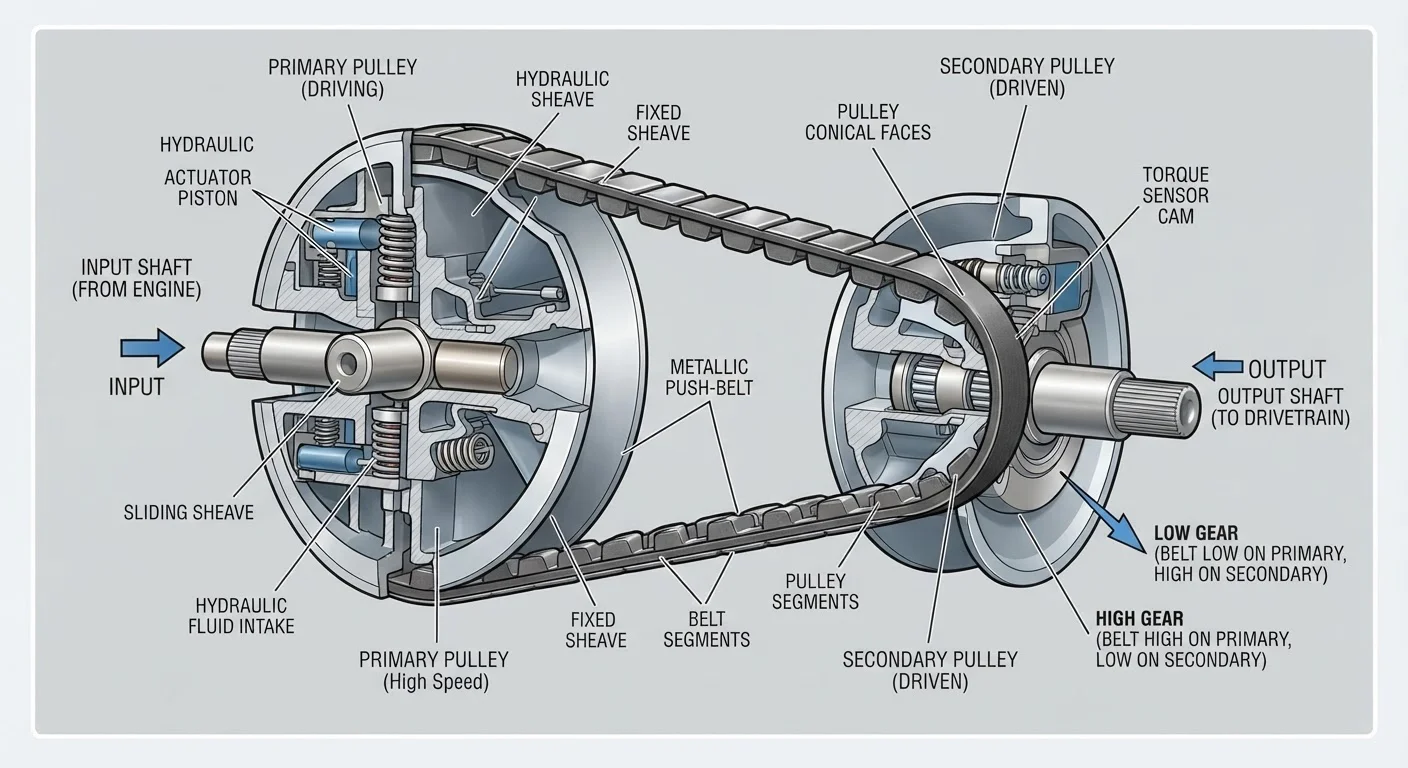
What a CVT Actually Does
A continuously variable transmission (CVT) replaces the fixed set of gears found in a traditional automatic with a belt-and-pulley system whose effective gear ratio changes fluidly across a continuous range. Rather than stepping from first to second to third gear, the CVT slides seamlessly between the lowest and highest ratios, always keeping the engine in its most efficient operating range for a given speed and load.
In practical terms, this means the engine often holds at a steady rpm while the car accelerates — a sensation that can feel counterintuitive if you're used to the familiar rise-and-fall of a stepped gearbox. That steady-rpm behavior is by design: it's what enables the fuel-economy advantage CVTs are known for.
For a broader comparison of how CVTs stack up against automatics, manuals, and dual-clutch transmissions, see our transmission comparison guide.
The Real Advantages of CVT Technology
CVTs offer a set of genuine, measurable benefits that explain why so many mainstream and hybrid vehicles use them.
Better fuel economy in most driving conditions
By keeping the engine closer to its optimal efficiency band, CVTs routinely achieve higher EPA city ratings than equivalent step-automatic vehicles. The benefit is most visible in urban, stop-and-go driving.
Smoother, jerk-free acceleration at normal pace
Without discrete gear shifts, power delivery in everyday driving feels seamless. Passengers often notice less drivetrain disturbance compared to traditional automatics during gentle acceleration.
Lighter weight and simpler mechanical packaging
CVTs typically contain fewer mechanical components than a six- or eight-speed automatic, which can reduce weight and manufacturing complexity — benefits that contribute indirectly to efficiency.
Well-suited to hybrid powertrain integration
Many hybrid systems pair naturally with CVTs because both prioritize keeping the engine in a narrow, efficient operating range. The Atkinson-cycle engines common in hybrids complement CVT behavior well.
~2–4 mpg
Typical city fuel economy advantage over step automatics
EPA comparison data across paired model variants commonly shows CVT-equipped versions posting measurably higher city ratings, though results vary by vehicle segment and engine size.
~30%
Share of new US passenger vehicles using CVTs
Industry transmission mix estimates suggest roughly a third of new non-electric vehicles sold in the US use CVT technology, concentrated in compact, midsize, and hybrid segments.
Because the engine spends more time near its efficiency sweet spot, CVT-equipped vehicles consistently post stronger EPA fuel economy numbers than comparable cars with traditional step automatics. This advantage is most pronounced in city driving, where frequent starts and stops would otherwise force a stepped gearbox to hunt through lower gears.
The smooth, stepless power delivery also reduces drivetrain shock — there are no gear-change jerks during light acceleration — which many drivers experience simply as a more refined, relaxed ride around town.
Where CVTs Fall Short
No transmission technology is without compromise, and CVTs carry real trade-offs that matter for some buyers more than others.
"Rubber band" sensation during hard acceleration
When pushed hard, the engine rpm rises and holds at a high level while the car builds speed, creating a disconnect between sound and sensation. Many drivers find this unintuitive or frustrating.
Less engaging driving feel for enthusiasts
CVTs lack the tactile feedback of gear changes that many drivers enjoy. Sport or paddle-shift modes partially compensate but are generally considered a simulation rather than a true substitute.
Fluid service requirements are easy to overlook
CVT fluid degrades differently than conventional automatic fluid, and neglecting changes can accelerate wear. Some earlier models suffered reliability problems partly due to overly optimistic factory service intervals.
Potentially higher repair costs when problems occur
If a CVT does fail outside warranty, replacement or rebuild costs can exceed those of a conventional automatic in some vehicle segments. Parts availability and technician familiarity vary by region.
The most commonly cited complaint is the "rubber band" effect: during brisk acceleration, the engine revs climb quickly and then hold at a high rpm while the car builds speed gradually beneath it. The disconnect between engine noise and vehicle response feels unnatural to many drivers accustomed to stepped gearboxes. Manufacturers have responded with simulated "stepped" shift programs that mimic traditional gear changes under hard acceleration — a partial fix that divides opinion.
Reliability perceptions also remain a lingering concern. Earlier CVT designs, particularly those from the late 1990s and 2000s, did show higher failure rates in some applications. Fluid degradation was a leading culprit, and many early service intervals were set too long. Current designs are generally more robust, but following the manufacturer's recommended transmission fluid change schedule remains important.
How to Evaluate a CVT Before You Buy
CVT Fluid Is Not Generic ATF
Many CVTs require a specific proprietary fluid — not standard automatic transmission fluid (ATF). Using the wrong fluid can damage internal components and void warranty coverage. Always verify the correct fluid specification in the owner's manual before any service, and use a qualified technician familiar with the specific transmission model.
If you're comparing vehicles and one uses a CVT, the spec sheet alone won't tell you how it feels. Take an extended test drive that includes city stop-and-go, a highway on-ramp merge, and moderate highway cruising — the three scenarios that reveal most about a CVT's real-world character.
Pay attention to how the transmission responds when you need a quick burst of speed: does it feel immediate, or sluggish before building momentum? Listen for excessive engine drone at steady highway speeds. Check the owner's manual for transmission fluid service intervals and factor that into your long-term ownership cost estimate.
Because fuel economy ratings are measured under controlled conditions, also consider how your actual driving patterns compare to EPA test cycles. If you spend most of your time on the highway rather than in the city, the CVT's efficiency advantage may be smaller than the window sticker implies. Understanding which specs matter most can help you weigh the numbers more critically.
Owner forums can surface real-world reliability patterns that reviews rarely capture. Using online research tools effectively explains how to sift credible owner feedback from noise.