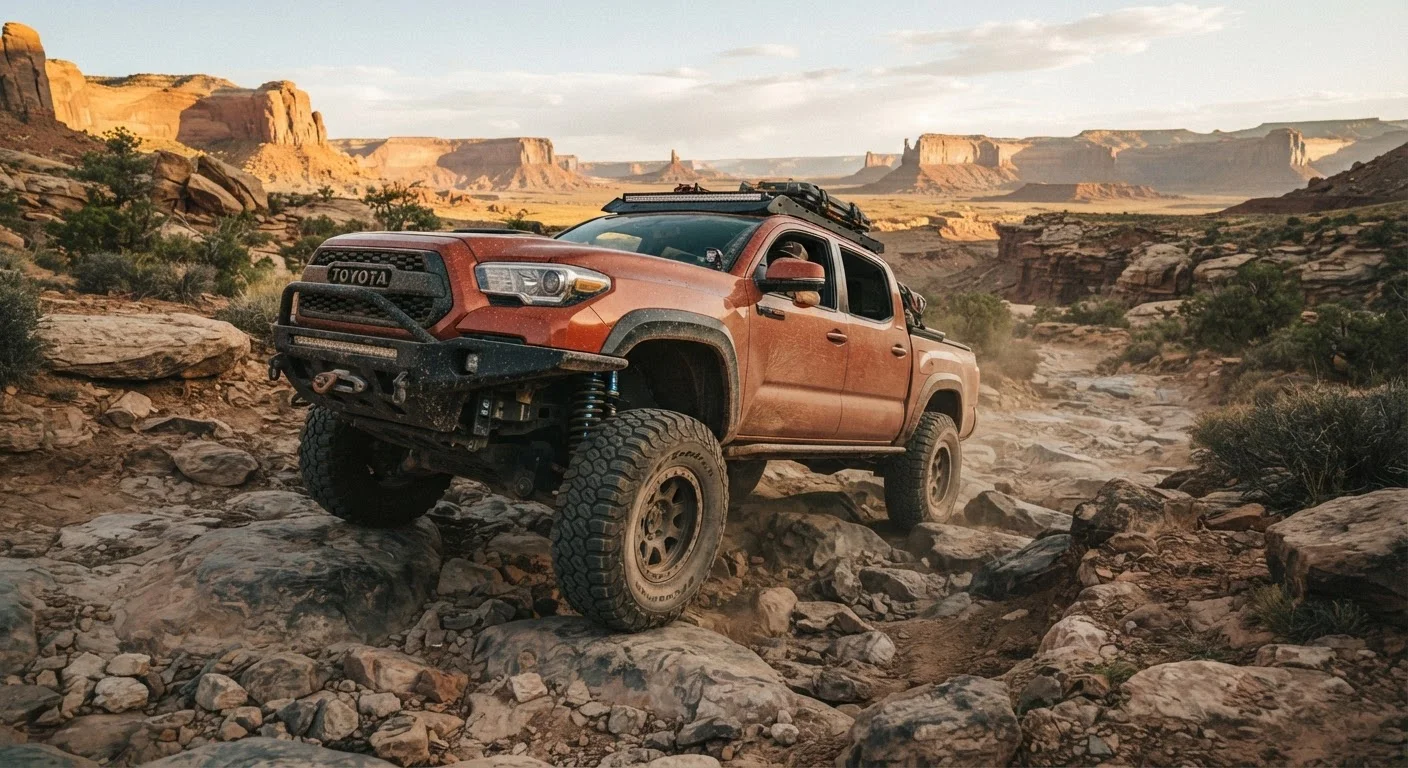
What Off-Road Trim Packages Actually Include
Automakers apply rugged-sounding names - Trail, Adventure, Rock, Wilderness, Raptor-style variants - to trim levels ranging from fully engineered off-road machines to lightly restyled commuter SUVs. The badge alone tells you almost nothing useful. What matters is the hardware list underneath it.
Genuinely capability-expanding features generally fall into a few categories: mechanical upgrades (locking differentials, low-range transfer cases, reinforced skid plates), suspension modifications (increased ride height, longer-travel shocks, sway-bar disconnect systems), and drivetrain tuning (dedicated terrain modes tied to actual throttle and brake calibration). Cosmetic additions - blacked-out trim, aggressive wheel arch cladding, off-road-pattern graphics - add visual personality but zero functional capability.
When evaluating any off-road trim, request the window sticker and compare specifications directly rather than relying on model-name associations. Ground clearance, approach angle, departure angle, and breakover angle are measurable figures that allow apples-to-apples comparisons across trims and brands. For a deeper explanation of how drivetrain configurations affect real-world performance, see the Performance & Drivetrain guide.
Common Myths Debunked
Several persistent misconceptions lead buyers to overestimate - or underestimate - what an off-road trim delivers. Understanding the distinction between marketing language and engineering substance is the clearest path to an informed decision.
Myth
If a truck or SUV has '4WD' and an off-road trim name, it can handle serious trail driving.
Fact
Part-time 4WD without low-range gearing is limited on steep or technical terrain; low-range is a non-negotiable for serious off-roading.
Four-wheel drive engagement distributes power to all four wheels, but without a low-range transfer case, wheel speed remains too high for slow, precise obstacle navigation. Low-range gearing multiplies torque at low speed, allowing a driver to creep over rocks and ruts without wheel spin. Many crossover-based trims labeled as 4WD or AWD use single-speed systems calibrated for highway and light off-road use - not for technical trails. Always confirm whether the transfer case has a dedicated low range (4LO) setting before assuming trail capability.
Myth
All-terrain tires included in an off-road trim are proof the vehicle is trail-ready.
Fact
Tire pattern matters, but rim size, sidewall height, and load rating jointly determine actual off-road traction - and many trims compromise sidewall flex for styling.
An all-terrain tread pattern improves grip on loose surfaces compared to a highway tire, but the gains are substantially reduced when the rim diameter is too large. A taller sidewall - achieved through a lower profile number in the tire size, such as 265/70 versus 265/40 - provides the flex needed to conform to irregular terrain and absorb impacts. Many off-road trims pair all-terrain tires with large-diameter wheels optimized for visual appeal, resulting in short sidewalls that limit articulation and increase vulnerability to rim damage on rocks.
Myth
A higher ride height automatically means better off-road performance.
Fact
Ground clearance is one of several angles that determine what terrain a vehicle can clear; approach, departure, and breakover angles must all be evaluated together.
Ground clearance measures the lowest point of the vehicle above flat ground, but a vehicle with generous clearance and a long front overhang can still high-center or scrape its fascia on steep inclines. Approach angle (the maximum slope you can drive onto without the front bumper touching), departure angle (the same measurement for the rear), and breakover angle (the ridge a vehicle can crest without its undercarriage grounding) together describe real-world obstacle clearance. Published specs for all three are available in manufacturer documentation and provide a far more complete picture than clearance alone.
Myth
Electronic terrain modes make a vehicle as capable as mechanical upgrades like locking differentials.
Fact
Terrain modes optimize throttle and brake response but cannot overcome the physical limits imposed by open differentials or insufficient traction hardware.
Terrain management systems - which adjust throttle mapping, transmission shift points, and traction control intervention for surfaces like sand, mud, or rock - are genuinely useful tools that improve driver confidence and vehicle response. However, they operate within the constraints set by the underlying hardware. An open differential can still send all torque to a spinning wheel regardless of the drive mode selected. A locking differential mechanically forces equal torque to both wheels on an axle, making it physically more capable in wheel-lift or low-traction scenarios. Electronic aids complement mechanical capability; they do not replace it.
Myth
Skid plates on off-road trims are all equivalent in protection.
Fact
Skid plate material and coverage area vary significantly; steel plates over critical components differ substantially from decorative plastic fascias.
Manufacturers sometimes include skid plate-style styling elements made from molded plastic or thin stamped metal that offer little resistance to rock impacts. Functional skid plates are typically fabricated from steel or heavy-gauge aluminum and are mounted to the frame or subframe - not the body - covering the oil pan, transfer case, and fuel tank. Before assuming a trim's skid plates provide meaningful underbody protection, check the listed material and mounting specifications. This distinction is especially important when towing or loading the vehicle, where ground clearance decreases and underbody exposure increases.
It's also worth understanding that not all all-wheel-drive systems provide genuine off-road utility. Many crossover-based systems are designed primarily for wet pavement traction rather than low-speed technical terrain. AWD systems differ significantly in how they distribute torque under stress - a detail the trim name rarely clarifies.
Separating Substance from Styling
A useful framework: divide every off-road trim's feature list into two columns - structural and cosmetic. Structural features change what the vehicle can physically do. Cosmetic features change how it looks doing it.
Structural features to look for include: a proper two-speed transfer case with low-range gearing, electronically locking rear (or front and rear) differentials, underbody skid plates covering the engine oil pan and transfer case, suspension geometry tuned for increased articulation, and terrain-specific drive modes calibrated to the actual powertrain. Electronic aids like hill descent control and crawl-ratio management belong in this column too when they are properly integrated - not when they are simply badged onto an unmodified platform.
Cosmetic additions that carry no capability benefit include: wider body cladding not backed by wider track width, all-terrain-pattern tires on rims too large to provide adequate sidewall flex, fake skid plate fascias molded from plastic with no load-bearing function, and interior styling that mimics rally or trail aesthetics without ergonomic benefit. Some features buyers assume are off-road-grade - roof rails, tow hooks - may be rated for light-duty use only and should be verified against manufacturer specifications before being relied upon in the field.
For context on how similar over-promise dynamics appear across vehicle categories, see our look at features that rarely deliver real-world value. And if you are weighing an off-road package add-on at the dealership, understanding how to evaluate add-ons can help you assess whether the price premium reflects genuine value.