The Hidden Price Tag Inside Your Loan Term
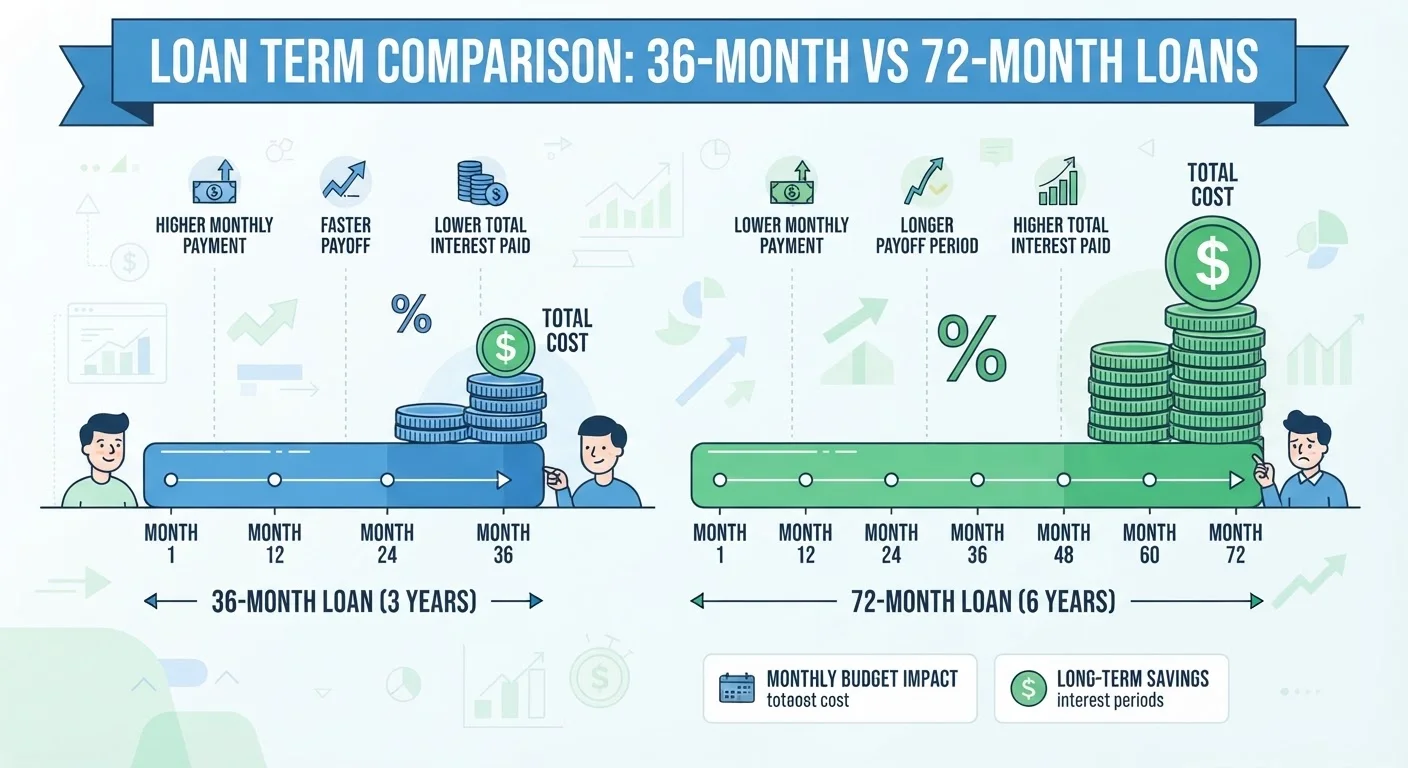
When you finance a car, the sticker price is only part of the story. The loan term - how many months you take to repay the debt - quietly determines how much the vehicle actually costs you. Two buyers can purchase the same $32,000 car at the same interest rate and end up paying very different totals based solely on the term they choose.
This trade-off sits at the heart of most auto financing decisions, yet it often receives far less attention than the monthly payment figure. Understanding how term length reshapes your total cost is essential before signing any loan agreement. For a broader foundation on how auto loans work, see the Auto Loans hub.
68+ months
Average new-vehicle loan term in recent years
Experian's State of the Automotive Finance Market reports have consistently shown average new-car loan terms exceeding 68 months as vehicle prices have climbed.
~$2,500
Extra interest on a 72- vs. 48-month $30K loan at 7%
This illustrative figure reflects standard amortization math on a $30,000 loan at 7% APR - actual amounts vary by rate and loan balance.
15-25%
Typical new-car depreciation in year one
Industry depreciation estimates from sources such as Edmunds and Carfax consistently place first-year new-vehicle value loss in this range, varying by make and model.
How Term Length Moves Monthly Payments and Total Interest in Opposite Directions
Every auto loan involves a fixed amount of principal, an interest rate, and a repayment schedule. Stretching the schedule over more months spreads the principal into smaller slices - which is why a 72-month loan feels more affordable month to month. But interest continues to accrue on the unpaid balance during every additional month you carry the debt.
Consider a $30,000 loan at 7% APR:
- 48 months: approximately $718/month - total paid roughly $34,450
- 60 months: approximately $594/month - total paid roughly $35,640
- 72 months: approximately $513/month - total paid roughly $36,950
The monthly payment drops by about $205 going from 48 to 72 months. But total interest paid nearly doubles - from around $4,450 to over $6,950. The lower payment comes at a real cost that isn't visible on any window sticker.
Your APR also interacts directly with term length. A higher rate amplifies the interest penalty of a long term. Understanding the difference between APR and your stated interest rate helps you compare loan offers accurately, since the APR captures fees as well as the base rate.
The Depreciation Problem: When You Owe More Than the Car Is Worth
New vehicles typically lose 15-25% of their value in the first year and continue depreciating steadily after that. Long loan terms amortize slowly - early payments are weighted heavily toward interest, not principal. This mismatch between how quickly the car loses value and how slowly you build equity creates a window of negative equity, commonly called being "upside down" on your loan.
If you need to sell, trade in, or total your vehicle while upside down, you'll owe more than the asset is worth. In a trade-in scenario, dealers often roll the remaining balance into your next loan - a cycle that can compound debt across multiple vehicles.
This risk is less severe with shorter terms because you pay down principal faster. It's a key reason many financial educators caution against 84-month loans in particular, even when the monthly payment seems manageable.
Strategies That Help You Manage Term Length Wisely
If a shorter term's monthly payment strains your budget, there are ways to reduce that pressure without defaulting to a very long loan.
- Increase your down payment. A larger upfront payment reduces the principal you finance, which lowers monthly payments on a shorter term without extending the loan.
- Buy a less expensive vehicle. Matching your vehicle price to your repayment capacity is more financially durable than using a long term to make an expensive car feel affordable.
- Make extra principal payments. If you do take a longer term for payment flexibility, paying even a modest amount above the minimum each month accelerates payoff and cuts interest. Paying more than the minimum each month can meaningfully shrink your total interest bill - the math compounds in your favor over time.
It's also worth examining why the monthly payment alone can mislead. Focusing on that single number without accounting for term and total cost is a common financing trap - one explored in depth in our piece on why focusing only on monthly payments can cost you more.
For a direct comparison of 36-, 48-, 60-, and 72-month options across cost dimensions, see short loan vs. long loan: which financing term fits your situation.
This article is for general informational and educational purposes only and does not constitute personalized financial, tax, or legal advice. Consult a qualified financial professional before making borrowing decisions specific to your circumstances.