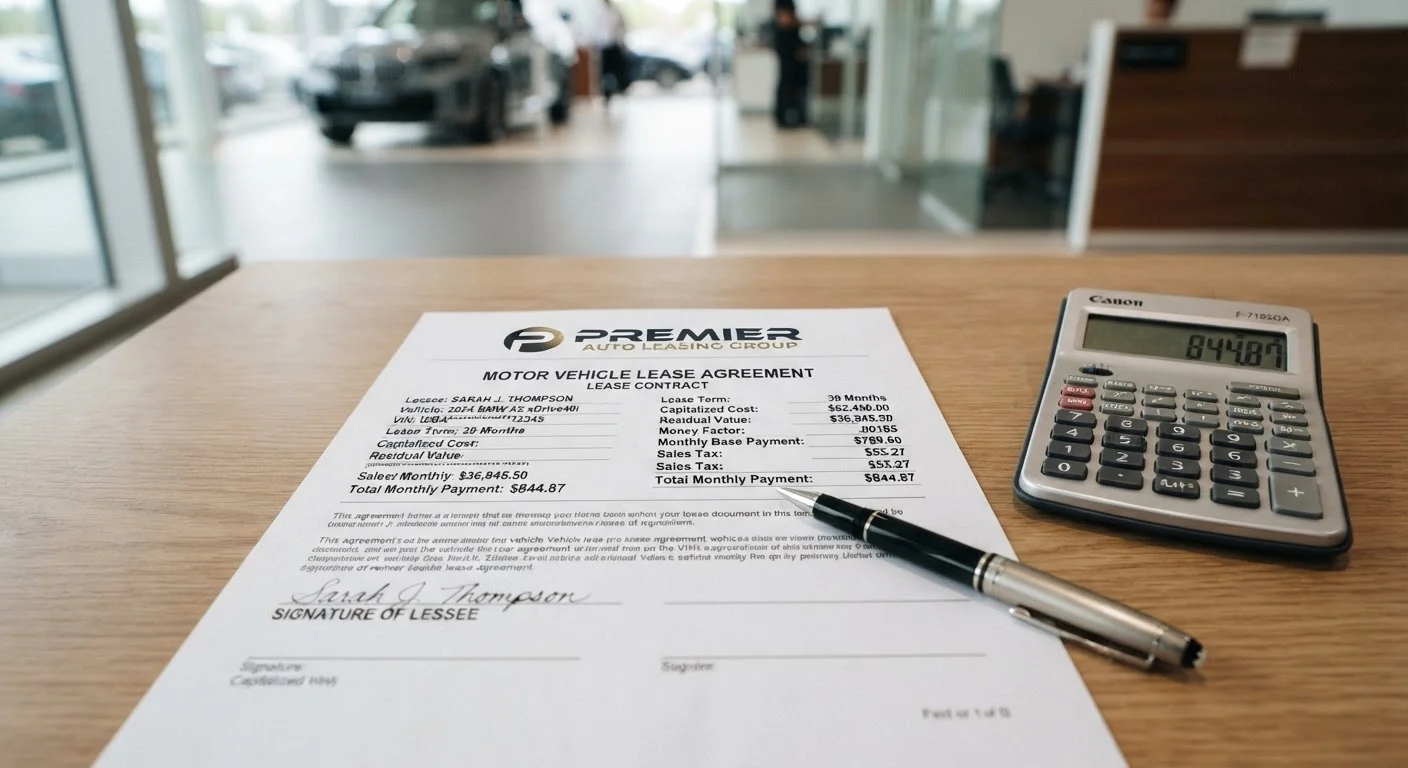
What Your Monthly Lease Payment Is Actually Paying For
A lease payment is not a single fee - it is the sum of several calculated components, each representing a different cost of using the vehicle. Most lessees see only the monthly figure, but understanding what sits beneath it allows you to evaluate whether a quoted payment reflects a fair deal or hidden expense. For a foundational overview of how these components interact, see Car Leasing Explained.
The four core building blocks of a lease payment are: depreciation charge, finance charge, taxes and government fees, and amortized upfront costs. Each is calculated separately and then added together to produce your monthly total.
Line by Line: Every Charge in a Lease Payment
1. Depreciation Charge
This is typically the largest portion of your payment. It represents the portion of the vehicle's value you are expected to consume over the lease term. The calculation is straightforward:
Depreciation Charge = (Adjusted Capitalized Cost − Residual Value) ÷ Number of Months
The adjusted capitalized cost is the negotiated vehicle price plus any rolled-in fees, minus any cap cost reductions (down payment, trade-in equity, or rebates). The residual value is the lessor's projected worth of the car at lease end, expressed as a dollar figure. A higher residual value means lower depreciation - and a lower monthly payment, all else equal.
2. Finance Charge (Money Factor)
Leases use a money factor rather than an annual percentage rate, though the two are related. The finance charge is calculated as:
Finance Charge = (Adjusted Cap Cost + Residual Value) × Money Factor
To convert a money factor to an approximate APR, multiply by 2,400. A money factor of 0.0020, for example, equates to roughly 4.8% APR. This charge compensates the lessor for the capital tied up in the vehicle throughout your lease. Compare this to how interest is structured in a traditional loan - our article on auto loan mechanics walks through that side of the equation.
3. Sales Tax and Government Fees
Most U.S. states tax lease payments monthly rather than taxing the full vehicle price upfront. This means tax is applied to the sum of your depreciation and finance charges each month. A small number of states tax the full capitalized cost at signing - the method depends on your state's specific regulations. Local fees such as registration and title costs may be collected at signing or rolled into the monthly payment depending on the lessor's structure.
4. Amortized Upfront Costs
Certain fees - most commonly the acquisition fee charged by the lender - are added to the capitalized cost and spread across the lease term rather than paid separately at signing. This makes them nearly invisible in payment quotes but meaningfully increases your monthly cost. Watch for gap insurance premiums, dealer add-ons, and extended warranty costs that may also be rolled in this way. For a deeper look at where lease quotes can obscure real costs, see why lease quotes can be misleading.
Capitalized Cost
The agreed-upon price of the vehicle that forms the basis of the lease calculation. It can be reduced by a down payment, trade-in value, or manufacturer rebates.
Residual Value
The lessor's estimate of the vehicle's worth at the end of the lease term, expressed in dollars. A higher residual value reduces the depreciation charge and therefore the monthly payment.
Money Factor
A small decimal number representing the financing cost of a lease, analogous to an interest rate. Multiply by 2,400 to convert to an approximate annual percentage rate.
Acquisition Fee
A fee charged by the leasing company (not the dealer) to originate the lease. It is often rolled into the capitalized cost and spread across monthly payments.
Adjusted Capitalized Cost
The capitalized cost after subtracting any cap cost reductions and adding rolled-in fees such as the acquisition fee. This is the figure used in the depreciation and finance charge calculations.
Cap Cost Reduction
Any upfront payment that lowers the capitalized cost - including a down payment, trade-in credit, or rebate. Reducing cap cost lowers the monthly depreciation charge.
Using the Breakdown to Compare and Verify
Once you can identify each component, you can check the math on any lease offer. Ask the dealer for the money factor, residual percentage, and adjusted cap cost in writing - a transparent lessor will provide all three. If a quoted payment is lower than your calculation suggests, look for an unusually high cap cost reduction being presented as standard, or fees buried in the capitalized cost. Our lease glossary defines each term you will encounter in the paperwork.
Before signing, cross-reference every line in the contract against these components. The pre-signing checklist details exactly what to verify. Also consider how your monthly budget shapes what you can realistically commit to - structuring a payment around your budget offers a methodical starting point.
This article provides general educational information about lease payment structures and is not personalized financial or legal advice. Lease terms, tax treatment, and fee structures vary by state, lender, and contract. Consult a qualified financial professional for guidance specific to your situation.