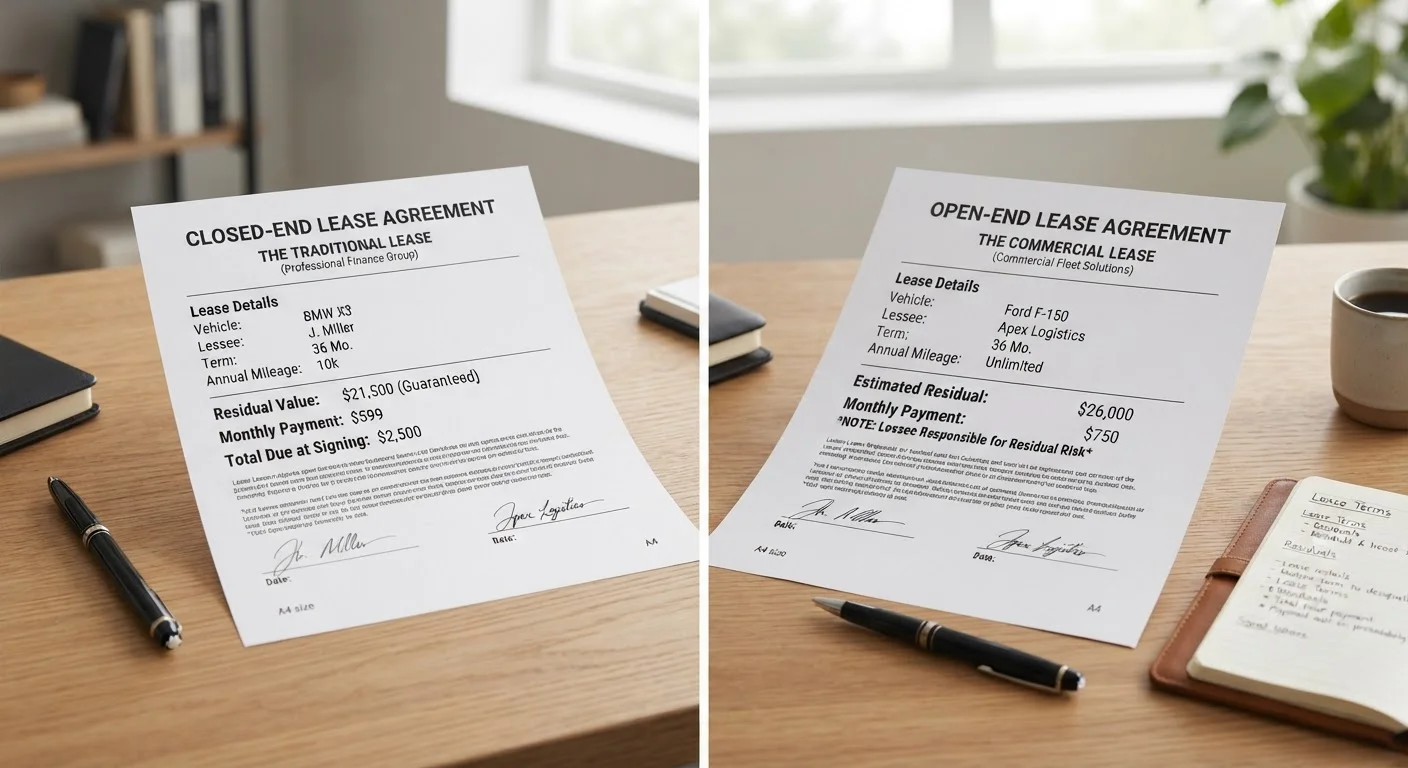
How Residual Value Risk Separates the Two Structures
Every car lease is built around a residual value - the projected worth of the vehicle at the end of the lease term. The fundamental difference between closed-end and open-end leases comes down to one question: who bears the risk if that projection turns out to be wrong?
In a closed-end lease (sometimes called a "walk-away" lease), the leasing company sets the residual value and absorbs any loss if the vehicle is actually worth less when you return it. You simply hand the keys back, pay any fees for excess mileage or damage beyond normal wear, and your obligation ends. The lessor made a bet on depreciation - and if they were wrong, that is their problem, not yours.
In an open-end lease, the calculation flips. If the vehicle's actual market value at lease end is lower than the contracted residual, you owe the difference. This is called a deficiency payment. Conversely, if the car is worth more than the residual, you may receive a refund of that surplus - though this scenario has historically been uncommon in standard depreciation cycles.
To understand how residual value fits into the broader math of any lease, see our explainer on how lease numbers work.
| Criterion | Closed-End Lease | Open-End Lease |
|---|---|---|
| Who bears residual value risk | The lessor (leasing company) | The lessee (you) |
| Primary user | Individual consumers | Commercial/fleet operators |
| End-of-term obligation | Return car; pay mileage/wear fees | Settle residual value gap if applicable |
| Mileage flexibility | Fixed annual allowance; fees for overages | Generally more flexible for high mileage |
| Predictability of total cost | High - costs largely set at signing | Lower - end-of-term costs vary with market |
| Equity built | None | None |
Who Each Lease Type Actually Serves
The consumer auto market is dominated by closed-end leases, and for good reason. When you lease a personal vehicle at a dealership, a closed-end structure gives you a predictable monthly payment, a defined mileage allowance (typically 10,000-15,000 miles per year), and a clean exit at term end - provided the vehicle is returned in acceptable condition. The risk of an unexpected depreciation shortfall never lands on your balance sheet.
Open-end leases, by contrast, are almost exclusively found in commercial and fleet contexts. A delivery company leasing a van that will accumulate 30,000 miles annually, or a business that needs to modify a vehicle for a specific purpose, may prefer the flexibility an open-end structure offers. The trade-off is meaningful: that business must be financially prepared to settle any residual value gap at the end of the term.
If you are an individual consumer reviewing a lease offer, you are almost certainly looking at a closed-end agreement. But understanding the open-end structure helps you recognize why fleet operators make different financing decisions - and why leasing versus owning involves very different risk profiles depending on your situation.
~80%
Consumer leases that use closed-end structure
Industry observers broadly estimate that the vast majority of retail auto leases in the US are closed-end, reflecting consumer preference for predictable costs.
$0.15-$0.30
Typical per-mile overage fee in closed-end leases
Excess mileage charges vary by lessor and vehicle segment; reviewing the lease contract before signing clarifies the exact rate that applies.
2-4 years
Typical closed-end consumer lease term
Most consumer closed-end leases run 24 to 48 months, aligning with manufacturer warranty periods and the steepest depreciation window.
End-of-Lease Obligations: What to Expect Under Each Structure
At the end of a closed-end lease, your obligations are relatively contained. You will typically be assessed for:
- Excess mileage fees - charged per mile over the contracted allowance (commonly $0.15-$0.30 per mile, though terms vary by lessor)
- Excess wear and tear - damage beyond what the lessor defines as normal use
- Disposition fee - a charge some lessors apply when you return the vehicle without purchasing it or re-leasing
None of these involve market risk. Your exposure is predictable and bounded by the contract. For a full overview of what happens when the term closes, including the option to buy the vehicle, see your three choices when a car lease ends.
At the end of an open-end lease, the vehicle is typically appraised. If the appraised value is lower than the stated residual, you pay the deficiency. If it is higher, you may receive a credit. This settlement process introduces genuine uncertainty - particularly in volatile used-car markets where values can shift significantly over a two- or three-year term.
It is also worth noting that neither lease structure builds equity in the vehicle. Whether the structure is open or closed, you are paying for the right to use an asset, not to own it. Readers who want to weigh that against financing to own should also review our coverage of how auto loans compare as an alternative.
This article provides general educational information about lease structures and is not personalized financial or legal advice. Consult a qualified financial professional before making decisions based on your specific circumstances.