What Loan Term Length Actually Means for Your Budget
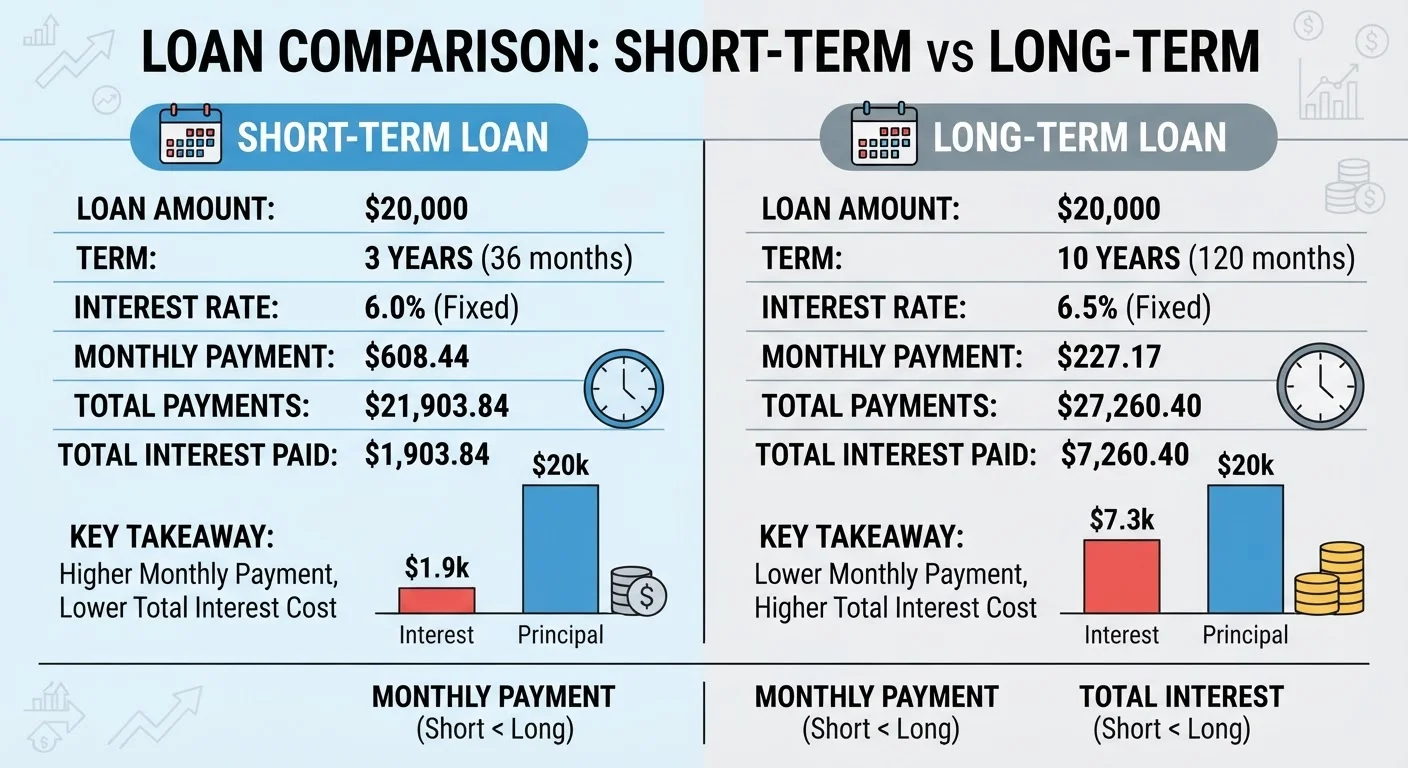
When you finance a used car, the loan term — the number of months over which you repay — determines two things simultaneously: your monthly payment and your total interest cost. These two figures move in opposite directions. Stretch the term out, and the monthly payment drops. But the total dollars flowing to the lender increase.
This trade-off is straightforward in principle but easy to underestimate in practice. A buyer focused on monthly affordability may accept a 72-month term without running the full-cost math. That decision can add hundreds of dollars — sometimes more — to what the car ultimately costs.
Understanding how auto loans work before you sign gives you leverage to negotiate on the terms that actually matter.
72 months
Most common long loan term offered for used cars
According to Experian's State of the Automotive Finance Market reports, 72-month loans have become one of the most prevalent term lengths for both new and used vehicle financing in the US.
~$1,000+
Potential extra interest on a longer used car loan
On a typical used car loan balance at common used-vehicle APRs, extending from a 36-month to a 72-month term can add well over $1,000 in total interest paid.
Higher APR
Rate premium lenders often charge on longer used car terms
Industry data consistently shows that used car loans with 60- and 72-month terms carry higher average APRs than shorter-term loans on the same vehicles.
How Interest Accumulates Over a Longer Term
Auto loans use simple interest, meaning each month's interest charge is calculated against your remaining principal balance. Early in the loan, a larger portion of each payment goes to interest; later payments shift toward principal. The longer you carry a balance, the more total interest you pay — even if the monthly amount looks manageable.
Consider a $15,000 used car loan at a 9% APR (a plausible rate for a used vehicle loan):
| Term | Monthly Payment | Total Interest Paid | Total Cost |
|---|---|---|---|
| 36 months | ~$477 | ~$1,170 | ~$16,170 |
| 48 months | ~$373 | ~$1,907 | ~$16,907 |
| 60 months | ~$311 | ~$1,656 | ~$18,656 |
| 72 months | ~$270 | ~$2,435 | ~$17,435 |
Figures are illustrative approximations only and will vary based on your actual rate, fees, and lender terms.
The monthly difference between 36 and 72 months is roughly $207 — but the interest cost more than doubles. That gap represents real money paid for the same vehicle.
The Negative Equity Risk Specific to Used Cars
Used vehicles depreciate quickly, often losing significant value in the first year or two of ownership. When your loan amortizes slowly over 60 or 72 months, your balance stays elevated while the car's market value falls. The result is negative equity: you owe more than the vehicle is worth.
This matters if you need to sell, trade in, or total the car before the loan is paid off. You would owe the difference between the loan balance and the car's value out of pocket — or roll it into a new loan, which compounds the problem.
Shorter-term loans reduce this exposure because the principal balance drops faster. For buyers comparing financing a new car versus a used car, it's worth noting that used vehicles typically carry higher depreciation risk relative to outstanding loan balances on longer terms.
Lender Rate Differences by Term Length
Many buyers assume the interest rate is fixed once a lender approves them. In practice, lenders frequently charge higher APRs on longer terms for used cars. A borrower approved at 8% for a 48-month loan might be quoted 9.5% or more for a 72-month term on the same vehicle. The factors lenders weigh when setting your loan terms — including vehicle age, mileage, and loan-to-value ratio — also influence whether longer terms are even available to you.
This means the cost difference between term lengths is often larger than it appears when you only compare monthly payments. Always ask for the APR and total interest figure alongside the monthly quote, and compare offers across multiple term lengths at the same principal amount.
Always Request the Total Interest Figure
When comparing loan offers, ask each lender for the total amount of interest you'll pay over the full term — not just the monthly payment or APR. This single number makes it easy to compare across term lengths and lenders without complex mental math. Some lenders are required to disclose this in the loan estimate; always review it before signing.
Choosing a Term That Matches Your Situation
There is no universally correct loan term, but there are clear trade-offs to weigh. If monthly cash flow is tight, a longer term may be necessary to keep payments manageable — but go in knowing the total cost. If you can absorb a higher monthly payment, a shorter term saves money and builds equity faster.
A practical starting point: calculate what 36-, 48-, and 60-month payments would look like for the loan amount you need, then assess whether the shorter-term payment fits your budget without crowding out essentials. For a structured comparison across term scenarios, see our short loan vs. long loan guide.
One general principle applies broadly: avoid stretching to the longest available term simply to reduce the monthly figure. The vehicle's useful life, depreciation curve, and your likelihood of keeping it through the loan's end all factor into whether a long term serves your interests.
This article is for general informational purposes only and does not constitute financial or legal advice. Consult a qualified financial professional before making borrowing decisions specific to your situation.