How a Good Price Negotiation Can Still Lead to Overpaying
Securing a lower price on a vehicle is a meaningful achievement - but it represents only one stage of a multi-step transaction. The moments after a price is agreed upon are where many buyers quietly lose the savings they worked hard to earn.
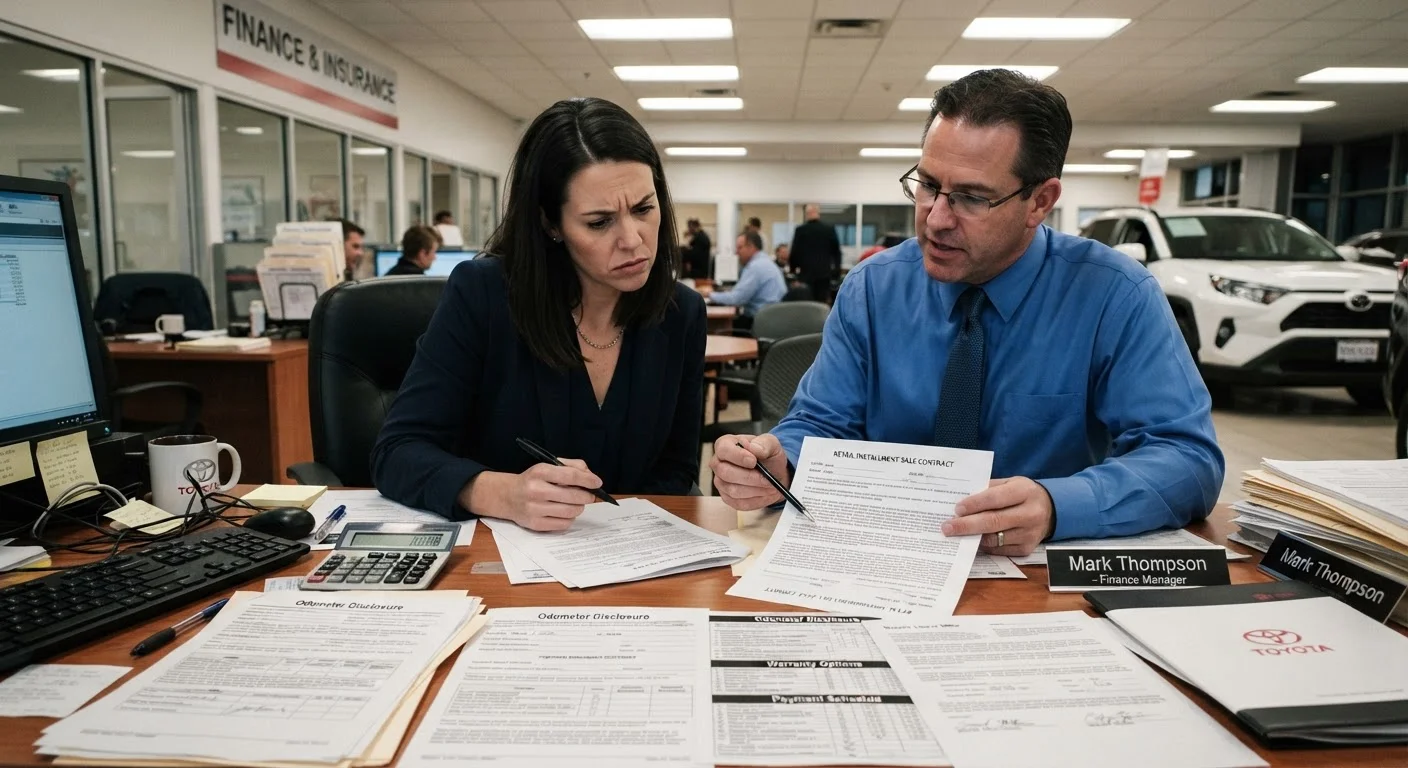
The car-buying process typically moves from the sales floor, where price is discussed, to the finance and insurance (F&I) office, where loan terms, add-ons, and final paperwork are handled. Each of these stages carries its own set of financial decisions. Buyers who arrive unprepared for the F&I portion often leave having paid more than they expected - even when the sticker negotiation felt successful.
Understanding where these additional costs tend to emerge is the first step toward protecting your budget through the entire purchase process. The mistakes below reflect the most common points where money slips away after a price has already been agreed upon.
The Common Mistakes That Undo a Good Price Negotiation
Agreeing to dealer add-ons presented as mandatory or already installed.
Why it happens: During the F&I process, items like paint protection, fabric sealant, or GPS tracking are often presented as pre-installed or standard, making buyers feel the cost is unavoidable.
Switching focus to monthly payment rather than the total loan cost.
Why it happens: A lower monthly figure feels like a win, but it often reflects a longer loan term rather than a lower price. Extending a loan from 48 to 72 months significantly increases the total interest paid.
Accepting the dealer's first financing rate without comparison.
Why it happens: Buyers who haven't arranged outside financing often accept the first rate quoted, assuming it reflects their credit profile accurately. Dealers receive rate markups from lenders as compensation, meaning the quoted rate may be higher than what was approved.
Allowing the trade-in and purchase to be negotiated as a single bundled transaction.
Why it happens: Dealers sometimes present trade-in value and vehicle price as one calculation, making it difficult to evaluate either number independently. A generous-looking trade-in offer can mask a higher vehicle price.
Skipping a thorough review of the final contract before signing.
Why it happens: After hours at the dealership, buyers are often fatigued and eager to finish. The finance manager may present documents quickly, and buyers sign without verifying that agreed-upon figures match the paperwork.
One area that deserves particular attention is how the total vehicle cost is structured. Buyers who focus narrowly on a single number - whether it's the sticker price or the monthly payment - can miss the full picture. For a detailed breakdown of this distinction, see monthly payment vs. total price negotiation.
Trade-in decisions also have a broader impact than many buyers realize. If you're comparing used vehicle deals alongside a trade-in offer, review what buyers commonly miss when comparing used car deals so you can evaluate each component of the offer on its own terms.
The Deal Isn't Done at the Sales Desk
Many buyers assume that agreeing on a vehicle price means the financial negotiation is over. In reality, the finance and insurance (F&I) office is a separate, structured environment where additional products and terms are introduced. Every item presented there affects your total cost of ownership - not just your monthly payment. Review every line with the same scrutiny you applied to the sticker price.
Approaching the Signing Stage With Confidence
The signing stage is not a formality - it is the moment when every number discussed during negotiation is either honored or quietly altered. Buyers who treat contract review as a checklist rather than a quick courtesy are far better positioned to catch discrepancies before they become binding.
Before leaving the dealership, confirm that the interest rate, loan term, down payment, and any agreed-upon inclusions or exclusions appear exactly as discussed. If anything has changed without explanation, pause and ask for clarification in writing.
Preparation remains the most reliable protection. Arriving with pre-arranged financing, a clear sense of your trade-in's standalone value, and a willingness to question every line item puts you in a stronger position at every stage - not just at the sales desk. If you're also evaluating a lease rather than a purchase, understand where lease quotes can hide extra costs so that favorable-looking monthly figures don't mask a more expensive deal overall.